Croke Park Capacity, Ownership and Rule 42
On this page7
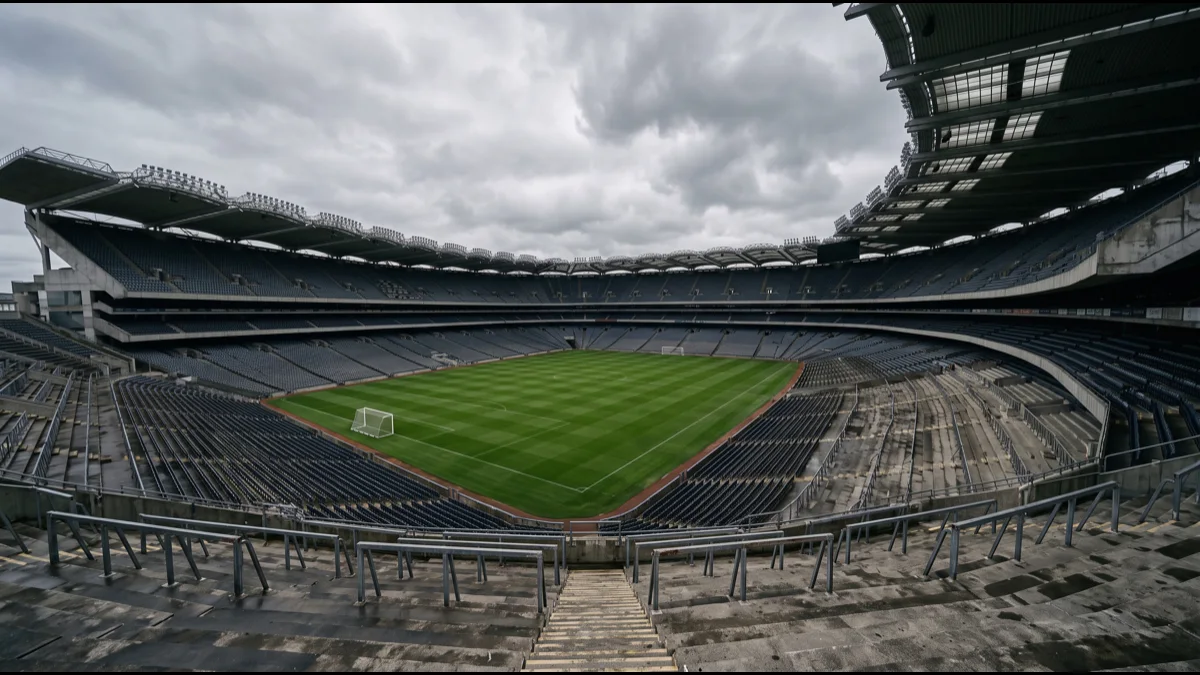
Croke Park holds 82,300. That makes it the largest stadium in Ireland by more than 30,000 seats, and one of the four largest in Europe. It is also one of eight GAA grounds in Ireland’s nine largest stadiums.
It is also owned by an amateur sporting association whose players are not paid — which makes it, almost certainly, the largest stadium in the world in amateur hands.
| Capacity | 82,300 |
| Largest in | Ireland |
| Rank in Europe | 3rd or 4th, depending on the Bernabéu figure |
| Owner | Gaelic Athletic Association (GAA) |
| Redeveloped | Four phases, 1993–2005 |
| 2004 phase cost | ~€266 million |
| Standing terrace | Hill 16, northern end |
Why its European ranking is disputed
You will see Croke Park called the third largest stadium in Europe and also the fourth. Both claims are defensible, and the reason has nothing to do with Croke Park.
Ahead of it sit Camp Nou (105,000 by design) and Wembley (90,000). The contested position is the Santiago Bernabéu, whose post-renovation capacity Real Madrid has never officially confirmed — reported figures range from about 78,000 to 85,000. On the most-cited figure of 83,186 the Bernabéu edges ahead and Croke Park is fourth. On a lower figure, Croke Park is third.
Our ranking of the largest stadium in Europe places it fourth and flags the Bernabéu, because that is where the evidence currently points rather than where it definitively rests.
Owned by amateurs, and it shows in the rulebook
The GAA is an amateur association. Its footballers and hurlers are unpaid, and its grounds have historically been governed by the association’s own constitution rather than by commercial logic.
It is also owned by its own members, and reinvested 83 cent of every euro of its €142 million 2025 revenue back into the game — set out in our guide to who owns the GAA.
The clearest expression of that was Rule 42, which for most of the GAA’s history banned non-Gaelic sports — described in the rulebook as foreign games — from being played at its grounds. Soccer and rugby were not permitted at Croke Park at all.
That changed on 16 April 2005, when the GAA Annual Congress passed a motion giving Central Council the power to authorise renting or leasing Croke Park for outside events during the period when Lansdowne Road was closed for redevelopment. It was a temporary, conditional relaxation tied to a specific circumstance, not a general opening of the ground.
The consequence was that Ireland’s rugby and soccer internationals were played at Croke Park while their own stadium was rebuilt — a genuinely significant moment in Irish sport, and one that happened only because the alternative venue was a building site.
The Euro 2028 omission
Here is the irony. Euro 2028 is co-hosted by Ireland, Dublin is a host city, and Croke Park is not a venue.
The only Irish ground selected is Dublin Arena — the Aviva Stadium under its UEFA-stripped name — at roughly 51,700. Croke Park is more than 30,000 seats larger and sits about three kilometres away.
Ireland’s largest stadium will sit empty during its own country’s home tournament. Our guide to the Euro 2028 venues sets out the full nine-venue list and the other large grounds left out, including Old Trafford, Twickenham and Murrayfield.
Hill 16, and why a modern stadium kept a terrace
Hill 16 is the standing terrace at the northern end. Retaining it through a complete redevelopment was a deliberate choice, and an unusual one — almost every major stadium rebuilt in this period converted entirely to seating.
A new terraced area was built at a cost of around €25 million to replace the old Nally Stand and Hill 16, preserving a standing end rather than eliminating it. The result is an 82,300-capacity stadium that still has a terrace, which is close to unique at this scale in Europe.
For anyone comparing capacities, this matters: part of Croke Park’s total is standing, so it is not a like-for-like comparison with an all-seater of the same number. That definitional problem runs through most stadium lists, as our guide to the the UK capacity rankings explains.
Rebuilt without missing a final
The redevelopment ran in four phases between 1993 and 2005, with the 2004 phase alone costing about €266 million.
The phasing was deliberately staged so that Croke Park never missed hosting an All-Ireland final during construction. That constraint shaped the whole project: rather than closing and rebuilding, the GAA replaced the ground around itself, one stand at a time, over twelve years.
It is a useful counterpoint to Camp Nou, which is doing something similar now and finding it costly — Barcelona’s staged rebuild has left the nominal largest stadium in Europe with roughly 62,652 usable seats for a sustained period.
What the capacity figure does not tell you
Croke Park is the headquarters of Gaelic games, hosts the All-Ireland football and hurling finals, and has staged NFL regular-season fixtures, concerts and the rugby and soccer internationals that Rule 42’s relaxation permitted.
For the wider context, see our rankings of the largest stadium in Europe and the biggest stadiums in the world, or the full set in our stadiums hub.
How we checked these numbers
Capacity, ownership, the four-phase redevelopment timeline and the €266 million and €25 million figures are from Croke Park’s own site cross-referenced with Wikipedia’s stadium entry and IrishCentral. The Rule 42 relaxation date and its conditional wording are from the Rule 42 record. The Euro 2028 venue list is from UEFA’s official venue guide.
The 82,300 figure includes standing accommodation on Hill 16, which is stated because it is not comparable with an all-seater total of the same size. The European ranking is given as a range because the Bernabéu comparison is genuinely unresolved.
Review class: stable, with event-driven triggers — recheck on any capacity revision, if Real Madrid confirms a Bernabéu figure, or if the Euro 2028 venue list changes.
Frequently asked questions
What is Croke Park's capacity?+
82,300, which makes it the largest stadium in Ireland by a wide margin and one of the four largest in Europe. Part of that total is Hill 16, a standing terrace at the northern end, which is unusual for a modern stadium of this size.
Who owns Croke Park?+
The Gaelic Athletic Association, an amateur sporting body whose players are not paid. That makes Croke Park almost certainly the largest stadium in the world owned by an amateur association, and it is why the ground's use has historically been governed by the GAA's own rulebook rather than commercial considerations.
What was Rule 42?+
A GAA rule that for most of the association's history banned non-Gaelic sports — described as foreign games — from being played at its grounds, Croke Park included. On 16 April 2005 the GAA Annual Congress passed a motion allowing Central Council to authorise renting the ground for other events while Lansdowne Road was being redeveloped.
Is Croke Park a Euro 2028 venue?+
No. Despite Euro 2028 being co-hosted by Ireland and Dublin being a host city, the only Irish venue selected is Dublin Arena — the Aviva Stadium — at roughly 51,700. Croke Park, more than 30,000 seats larger and in the same city, is not being used.
Is Croke Park bigger than Wembley?+
No. Wembley holds about 90,000 against Croke Park's 82,300. Croke Park is usually placed third or fourth in Europe depending on which figure is used for the rebuilt Santiago Bernabeu, whose capacity Real Madrid has never officially confirmed.
What is Hill 16?+
The standing terrace at the northern end of Croke Park, retained through the redevelopment as a deliberate decision to preserve the ground's character. A new terraced area was built at a cost of around €25 million to replace the old Nally Stand and Hill 16 while keeping a standing end.
How much did Croke Park cost to redevelop?+
The ground was rebuilt in four phases between 1993 and 2005, with the 2004 renovation phase alone costing about €266 million. The phasing was deliberately staged so that Croke Park never missed hosting an All-Ireland final during construction.
Sources
Related stadiums & arenas guides
View all →
Biggest Stadiums in Ireland: An Amateur Monopoly
Croke Park leads at 82,300, but the real story is that eight of Ireland's nine largest stadiums are owned by an amateur association.
Signal Iduna Park Capacity: 81,365 or 65,829
Germany's largest stadium holds 81,365 for the Bundesliga and 65,829 for UEFA matches. The 15,536-seat gap is the Yellow Wall being sat down.

Who Owns the GAA: Its Own Members
Europe's fourth-largest stadium belongs to an amateur association run by volunteers. It turned €142m of revenue into a €3.7m surplus — on purpose.
Euro 2028 Venues: All Nine Stadiums Ranked
Euro 2028 uses nine stadiums across eight UK and Irish cities. Capacities, why UEFA renames them, and the big grounds that were left out.
Anfield Capacity: 45,000 to 61,000 Without Moving
Anfield grew by 16,000 seats in 13 years through two stand rebuilds. At roughly $10,300 a seat it is half the cost per seat of a new stadium.
Principality Stadium Capacity: 73,931 and a Roof
Cardiff holds 73,931 for rugby and about 78,000 for boxing. And the famous rule that both teams must agree to close the roof no longer applies.