10 Most Expensive NFL Stadiums Ever Built
On this page12
- 01How we ranked the most expensive NFL stadiums
- 02Most expensive active NFL stadiums ranked in 2026
- 031. SoFi Stadium: about $5.5 billion
- 042. Allegiant Stadium: $1.97 billion
- 053. MetLife Stadium: about $1.6 billion
- 064. Mercedes-Benz Stadium: about $1.5 billion
- 075. AT&T Stadium: about $1.3 billion
- 086. Levi’s Stadium: about $1.3 billion
- 097. U.S. Bank Stadium: $1.1 billion
- 108-10. Lucas Oil, Lincoln Financial and State Farm
- 11Nominal cost versus inflation-adjusted cost
- 12Future NFL stadiums that may enter the ranking
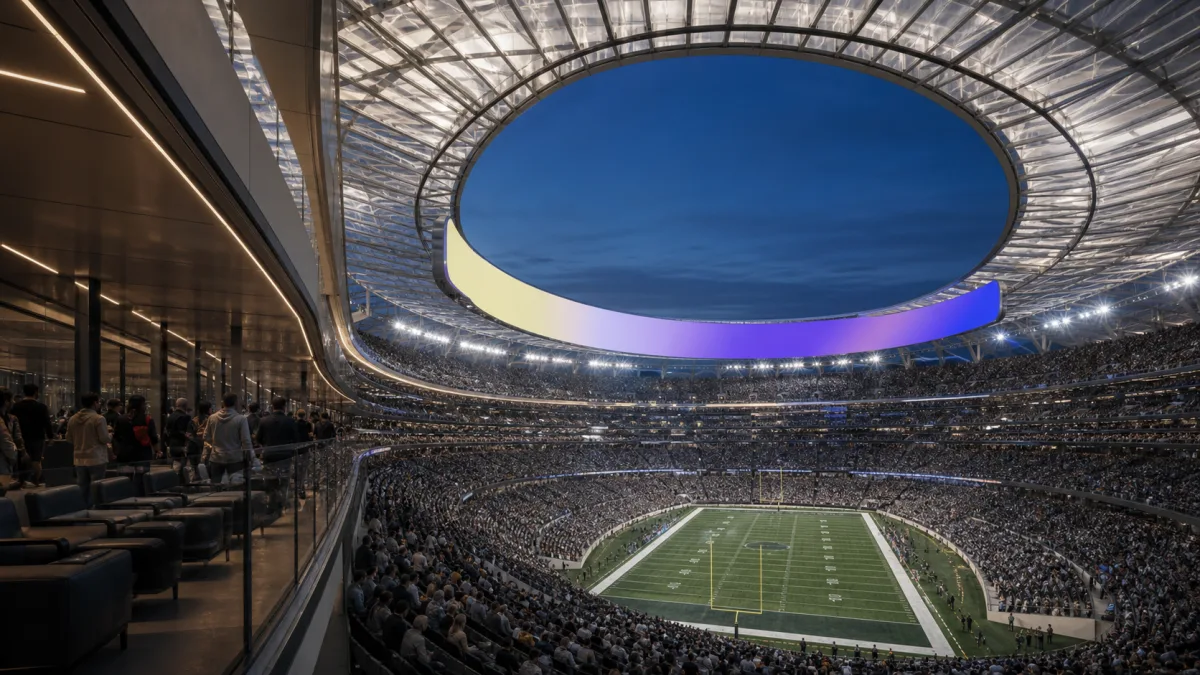
SoFi Stadium is the most expensive stadium in the NFL, at a widely reported $5.5 billion. Allegiant Stadium is a distant second at $1.97 billion. Even allowing for inconsistent project accounting, nothing else is close enough to challenge SoFi’s top spot.
How we ranked the most expensive NFL stadiums
This is a nominal construction-cost ranking of active NFL home stadiums. We use the best documented project total available in contemporary dollars and keep surrounding entertainment districts separate when a source allows that split. The figures are not converted into today’s dollars because inflation adjustment answers a different question and can change the order.
Renovation packages are excluded when they cannot be separated from the original build. Proposed stadiums also stay outside the active ranking until they open, which is why the future projects discussed below do not appear in the top ten.
Most expensive active NFL stadiums ranked in 2026
The table uses nominal dollars reported around completion. It does not adjust an older stadium’s price into 2026 dollars, because mixing nominal and adjusted numbers creates a ranking that cannot be reproduced.
| Rank | Stadium | Team(s) | Opened | Reported project cost |
|---|---|---|---|---|
| 1 | SoFi Stadium | Rams, Chargers | 2020 | About $5.5 billion |
| 2 | Allegiant Stadium | Raiders | 2020 | $1.97 billion |
| 3 | MetLife Stadium | Giants, Jets | 2010 | About $1.6 billion |
| 4 | Mercedes-Benz Stadium | Falcons | 2017 | About $1.5 billion |
| 5= | AT&T Stadium | Cowboys | 2009 | About $1.3 billion |
| 5= | Levi’s Stadium | 49ers | 2014 | About $1.3 billion |
| 7 | U.S. Bank Stadium | Vikings | 2016 | $1.1 billion |
| 8 | Lucas Oil Stadium | Colts | 2008 | About $720 million |
| 9 | Lincoln Financial Field | Eagles | 2003 | About $512 million |
| 10 | State Farm Stadium | Cardinals | 2006 | About $455 million |
These are approximate project figures, not audited apples-to-apples accounts. Land, roads, parking, financing costs and adjacent development may sit inside one published number and outside another. The ranking is most dependable at the top, where the gaps are large.
1. SoFi Stadium: about $5.5 billion
SoFi Stadium opened in Inglewood in 2020 as the shared home of the Los Angeles Rams and Chargers. The venue’s commonly reported cost ranges from about $5 billion to $5.5 billion depending on the date and scope of the estimate.
It is not a conventional roofed building. The stadium bowl sits below ground because of airport height restrictions, while a huge freestanding ETFE canopy spans the bowl, a plaza and an indoor performance venue. A double-sided 360-degree video board hangs above the field.
The wider Hollywood Park site contains offices, homes, retail, a hotel and public space. Some figures discussed for the development exceed the stadium number, which is why a source that says $5 billion and one that says $5.5 billion may both be describing defensible but different boundaries. The current NFL capacity table records SoFi’s standard 70,240 seats.
2. Allegiant Stadium: $1.97 billion
The Raiders’ own completion announcement put Allegiant Stadium at $1.97 billion. The 1.8-million-square-foot enclosed venue opened in 2020 near the Las Vegas Strip.
Its signature engineering includes a lightweight translucent roof, operable walls facing the Strip and a natural-grass field tray that rolls outside for sunlight. UNLV plays on an artificial surface underneath when the NFL field is outside.
The project received $750 million in public financing backed by a hotel-room tax, then a record public contribution for a US stadium. The balance came through the Raiders, NFL financing, seat licenses and bank debt.
3. MetLife Stadium: about $1.6 billion
MetLife Stadium opened in East Rutherford in 2010 at roughly $1.6 billion, making it the country’s most expensive stadium at the time. The Giants and Jets privately financed the building through their joint stadium company, while public bodies remained involved in land, transport and surrounding infrastructure.
Sharing changes the economic comparison. MetLife serves two full NFL schedules, as does SoFi, while most expensive venues host one team. Its 82,500 seats also make it the largest NFL stadium by standard capacity.
4. Mercedes-Benz Stadium: about $1.5 billion
Atlanta’s Mercedes-Benz Stadium opened in 2017 with a final price generally reported near $1.5 billion. Its eight-panel retractable roof was designed to open like a camera aperture, and the oval video halo avoids the central hanging board used in many domes.
Public financing came through Atlanta’s hotel-motel tax, with Falcons owner Arthur Blank covering overruns. The stadium replaced the Georgia Dome on an adjacent site and was built for both the Falcons and Atlanta United.
5. AT&T Stadium: about $1.3 billion
AT&T Stadium cost roughly $1.3 billion when it opened in Arlington in 2009. The Cowboys supplied most of the project financing, while the city contributed a sales-tax package capped at $325 million.
The building’s retractable roof, enormous center-hung screens and expandable standing-room decks made it a template for the event-first NFL stadium. It lists about 80,000 seats but can exceed 100,000 for selected events, an important distinction in our largest US stadiums comparison.
6. Levi’s Stadium: about $1.3 billion
Levi’s Stadium opened in Santa Clara in 2014 at approximately $1.3 billion. It was financed through the Santa Clara Stadium Authority, team-linked revenue, seat licenses, naming rights and commercial borrowing rather than a simple owner-versus-taxpayer split.
The open-air design looks less elaborate than a modern dome, but Silicon Valley construction costs, premium space and its technology system drove the price. Major later renovations for Super Bowl LX and the 2026 World Cup are separate from the original build figure.
7. U.S. Bank Stadium: $1.1 billion
The Vikings reported a $1.1 billion build cost when U.S. Bank Stadium opened in Minneapolis in 2016. Its fixed roof uses a large expanse of transparent ETFE, giving the interior daylight without the weight and mechanical complexity of a retractable roof.
The team said it committed $607 million, or 54 percent of capital cost, with the state and city providing the remainder under the original package and related additions. The angular enclosed building replaced the Metrodome on the same downtown site.
8-10. Lucas Oil, Lincoln Financial and State Farm
Three pre-2010 projects round out the nominal top ten:
- Lucas Oil Stadium opened in Indianapolis in 2008 at about $720 million, with a retractable roof and movable end-zone window.
- Lincoln Financial Field opened in Philadelphia in 2003 at about $512 million. Later renovation programs do not reset its original construction cost.
- State Farm Stadium opened in Glendale in 2006 at about $455 million. Its entire natural-grass field rolls outdoors, while the roof closes over the event floor.
Inflation makes these numbers look deceptively small beside a 2020 build. That is why the table answers “which project had the highest reported price at the time,” not “which imposed the greatest equivalent economic cost in 2026.”
Nominal cost versus inflation-adjusted cost
An inflation-adjusted ranking converts every project into the same year’s purchasing power. It is useful, but only when applied to every stadium with the same index and base date.
Front Office Sports, for example, has put SoFi around $6.75 billion and Allegiant around $2.33 billion in adjusted dollars. MetLife moves closer to Allegiant because its $1.6 billion was spent ten years earlier. The exact values keep changing with the chosen inflation month, so this page does not place those moving figures in its primary table.
| Method | Best for | Limitation |
|---|---|---|
| Original nominal cost | What the project was reported to cost | Undervalues older construction in today’s money |
| Inflation-adjusted cost | Comparing purchasing power across years | Changes with index and base date |
| Cost per seat | Comparing capital intensity | Roofs, mixed-use areas and premium space distort it |
| Public contribution | Comparing taxpayer exposure | Definitions of infrastructure and tax breaks vary |
Future NFL stadiums that may enter the ranking
Several confirmed projects are expensive enough to disrupt the list, but estimates are not final costs and unfinished buildings are not active stadiums.
| Team / project | Current reported estimate | Target |
|---|---|---|
| Kansas City Chiefs new Kansas stadium | About $3 billion | 2031 |
| Cleveland Browns new Huntington Bank Field | About $2.6 billion | 2029 |
| Tennessee Titans New Nissan Stadium | About $2.1 billion | 2027 |
Jacksonville’s “Stadium of the Future” is a reconstruction rather than a separate ground-up stadium. Washington’s and Chicago’s projects also remain capable of changing scope and price. The live status and opening dates belong in our new NFL stadium tracker.
SoFi’s lead is safe unless a future project’s completed stadium cost moves far beyond today’s estimates. Compare it with Wembley, Tottenham and Singapore in our world’s most expensive stadiums ranking. For the buildings’ ages rather than their budgets, see the oldest NFL stadiums ranking and the wider stadiums hub.
Frequently asked questions
What is the most expensive NFL stadium?+
SoFi Stadium in Inglewood, California. Its commonly reported project cost is about $5.5 billion, nearly three times the $1.97 billion reported for second-place Allegiant Stadium.
Why did SoFi Stadium cost so much?+
The project excavated a huge sunken bowl, built a freestanding translucent canopy over the stadium and adjacent plaza, installed a double-sided oval video board and developed a difficult 298-acre site in greater Los Angeles. Some published totals also differ in how much surrounding development they include.
How much did Allegiant Stadium cost?+
The Raiders reported the completed facility at $1.97 billion in 2020. That includes the enclosed 65,000-seat stadium, retractable natural-grass field and major site work.
Was SoFi Stadium publicly funded?+
The stadium itself was privately financed by Rams owner Stan Kroenke and project borrowing. Public entities approved infrastructure and tax arrangements around the wider Hollywood Park development, so privately financed does not mean the public had no related costs or incentives.
Does this ranking adjust old stadium costs for inflation?+
No. It ranks the reported nominal project cost when each stadium was completed. Inflation-adjusted rankings answer a different question and can reorder older venues, so the two methods should not be mixed in one table.
Will future NFL stadiums enter this list?+
Yes, after they open and final costs are known. Announced projects for Kansas City, Cleveland and Tennessee carry estimates above $2 billion, but estimates can move and they are not active stadiums yet.
Sources
- Axios: SoFi Stadium's roughly $5 billion price tag
- Las Vegas Raiders: Allegiant Stadium completed at $1.97 billion
- Minnesota Vikings: U.S. Bank Stadium cost $1.1 billion
- Front Office Sports: NFL stadium construction costs
- Axios: Browns project reaches $2.6 billion
- Tennessee Titans: New Nissan Stadium project
- Kansas City Chiefs: new 2031 stadium announcement
Related stadiums & arenas guides
View all →
10 Most Expensive Stadiums in the World
SoFi Stadium is the world's most expensive at about $5.5 billion. Compare 10 costly stadium projects and see why published rankings differ.
Most Expensive Stadiums Ever Built, and the Catch
SoFi Stadium cost $5.5 billion, more than double anything else. But most cost rankings quietly mix inflation-adjusted and nominal figures — here's both.
New NFL Stadiums: Every Project From 2026 to 2031
Track every new NFL stadium from Buffalo to Kansas City, with opening dates, capacities, costs and clear status for confirmed builds and proposals.
12 Oldest NFL Stadiums Still in Use in 2026
Rank the oldest NFL stadiums by opening year, from Soldier Field and Lambeau to the 1990s venues, with renovations and replacements explained.
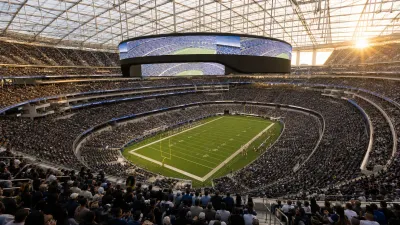
SoFi Stadium Capacity: NFL, Concerts and Soccer
SoFi Stadium holds 70,240 for football and can expand toward 100,000. See concert, World Cup and seating capacities explained clearly.
How Long to Build a Stadium: 26 Months or 12 Years
AT&T Stadium took 26 months. Croke Park took twelve years. The difference isn't engineering — it's whether the ground has to keep hosting matches.