MetLife Stadium Capacity: NFL, Concerts and Soccer
On this page12
- 01MetLife Stadium capacity at a glance
- 02Giants and Jets football capacity
- 03Is MetLife the largest NFL stadium?
- 04World Cup 2026 capacity and removed seats
- 05Why soccer capacity differs from NFL capacity
- 06MetLife Stadium concert capacity
- 07Seating levels and premium areas
- 08Best seats for football
- 09Best seats for concerts and soccer
- 10Why MetLife Stadium has no roof
- 11MetLife versus SoFi and AT&T Stadium
- 12Accessibility and transport planning
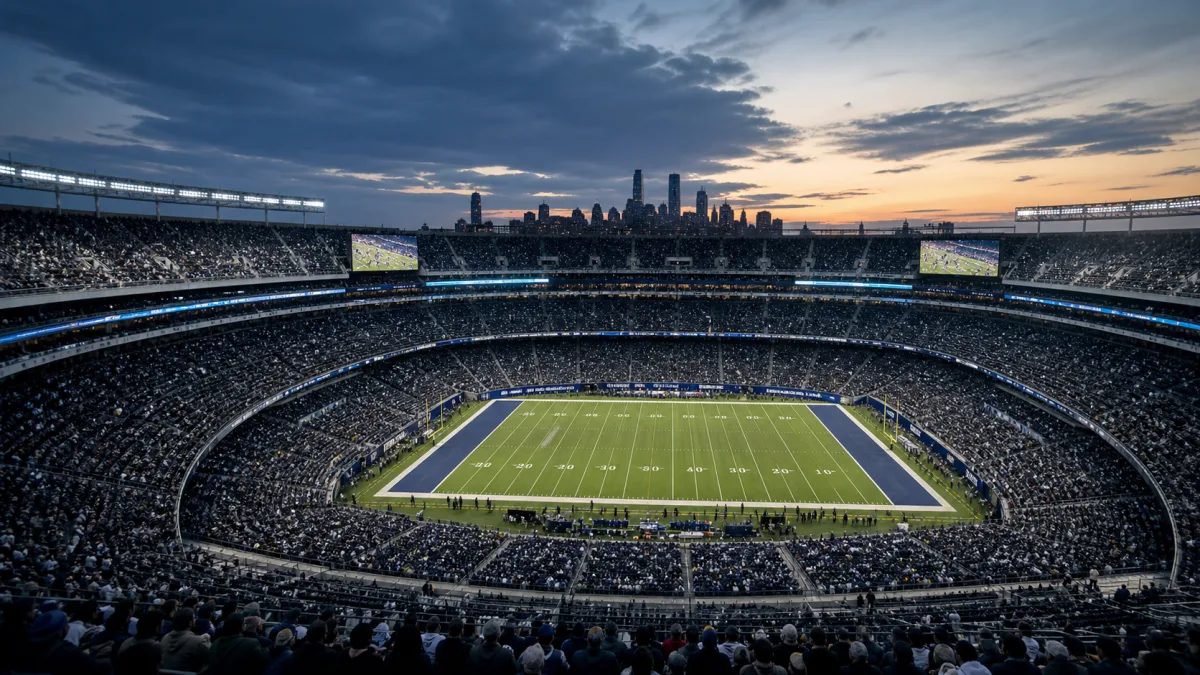
MetLife Stadium holds 82,500 spectators for a standard Giants or Jets game. That is the largest regular seating capacity of any active NFL stadium.
The number changes for soccer, concerts and wrestling because each event uses the field, lower bowl and production space differently. For the 2026 World Cup, the stadium removed 1,740 corner seats and operated at roughly 80,663 to fit a regulation-width soccer field.
MetLife Stadium capacity at a glance
| Configuration or record | Capacity / attendance | What it means |
|---|---|---|
| Standard NFL seating | 82,500 | Permanent football reference capacity |
| 2026 World Cup configuration | About 80,663 | After 1,740 corner seats were removed |
| World Cup bid-book estimate | 74,895 | Earlier net tournament estimate, not permanent capacity |
| Record NFL crowd cited before 2026 | 83,367 | Giants–Jets attendance, including event inventory |
| 2016 Copa América final | 82,026 | Argentina vs Chile soccer attendance |
| 2023 Ed Sheeran concert | About 89,000 | In-the-round stage plus field admission |
Use 82,500 for the building’s normal football capacity. The live ticket map is the relevant number for any particular concert or soccer match.
Giants and Jets football capacity
The New York Giants and New York Jets have shared MetLife Stadium since it opened in 2010. Thirty-two NFL franchises therefore use only 30 full-time stadiums: the Los Angeles teams share SoFi, and the New York teams share MetLife.
Both clubs play before the same 82,500-seat bowl. Digital displays, field markings, lighting and removable branding change between tenants, but the Giants do not own more seats than the Jets or vice versa.
Some games can announce slightly more than 82,500 because suites, standing positions or temporary event inventory are counted. That does not create a new permanent capacity. The same distinction applies when a sellout falls below 82,500 because operational holds never go on sale.
Is MetLife the largest NFL stadium?
Yes—when “largest” means standard seats. It leads the NFL’s active venues at 82,500, ahead of Lambeau Field’s 81,441 and AT&T Stadium’s roughly 80,000.
| Rank | NFL stadium | Standard capacity |
|---|---|---|
| 1 | MetLife Stadium | 82,500 |
| 2 | Lambeau Field | 81,441 |
| 3 | AT&T Stadium | About 80,000 |
| 4 | Arrowhead Stadium | 76,416 |
| 5 | Empower Field at Mile High | 76,125 |
AT&T and SoFi can pass 100,000 for selected events using standing and temporary inventory, but their ordinary football seating remains lower. Our largest NFL stadiums ranking applies that standard consistently across all 30 buildings.
World Cup 2026 capacity and removed seats
MetLife was temporarily renamed New York New Jersey Stadium for FIFA’s 2026 tournament. It hosted eight matches, including the final on 19 July.
American football’s playing surface is narrower than the full soccer footprint FIFA requires. Stadium officials removed 1,740 seats from lower-bowl corners and created retractable sections so the field could reach roughly 68 by 105 metres with appropriate run-off space.
The work reduced the configuration from 82,500 to about 80,663. An earlier World Cup bid document had estimated 74,895, showing how planning-stage net capacities change as engineering, broadcast and ticketing layouts are finalized.
The corner seats were intended to return after the tournament. Their removal was an event conversion, not a permanent downsizing of the NFL venue.
Why soccer capacity differs from NFL capacity
A soccer match needs more than a rectangle of grass. The complete event footprint includes advertising boards, photographer lanes, team benches, warm-up space and a safety buffer around the touchlines.
FIFA also reserves seating for:
- Broadcast cameras and commentary teams.
- Competition officials and technical operations.
- Teams, guests and hospitality programs.
- Supporter segregation and security buffers.
- Seats with restricted views after the field conversion.
That is why physical capacity, gross competition capacity and public tickets available are different numbers. The 82,026 crowd at the 2016 Copa América final used a narrower pre-conversion soccer setup.
MetLife Stadium concert capacity
There is no fixed concert capacity. A touring production can either remove tens of thousands of bowl seats from sale or use the field to push attendance above the NFL number.
| Stage type | Capacity effect |
|---|---|
| Large end stage | Closes sections behind the stage; often about 50,000–60,000 tickets |
| End stage with long runway | Adds engagement but removes floor and sightline inventory |
| Center / in-the-round stage | Opens most of the bowl and can exceed 82,500 with field admission |
| Reserved floor seating | Adds tickets while preserving aisles and technical zones |
| General-admission floor | Potentially adds more people, subject to safety rules |
Ed Sheeran’s center-stage show in June 2023 drew roughly 89,000, a venue concert record widely reported at the time. By contrast, sold-out end-stage shows can report crowds near 50,000 because a quarter of the bowl may sit behind the production.
A multi-night tour total is not a single-event capacity. Three shows drawing 55,000 each equal 165,000 tickets across the run, not a 165,000-seat stadium.
Seating levels and premium areas
MetLife has three main seating tiers plus clubs and suites:
- 100 level: closest to the field, with lower-bowl sidelines and end zones.
- 200 level: includes extensive club and premium seating.
- 300 level: upper deck, offering the broadest and usually least expensive views.
- Suites: private spaces positioned between seating tiers.
- Field and floor inventory: created only for appropriate non-football events.
The official venue lists five premium clubs with a combined capacity above 10,000 seats. Ticketmaster suites typically accommodate 16 to 24 guests. Access benefits depend on the specific product, not just the section number.
Best seats for football
For the cleanest tactical view, choose a sideline section near midfield. Lower rows provide player proximity, while the 200 level offers better depth and makes both end zones easier to judge.
Upper-deck central seats are a practical value choice. MetLife’s scale means they are far from the field, but the height makes formations and coverage develop clearly. Low end-zone seats are exciting near a touchdown and less informative when play moves to the opposite end.
Weather should influence the choice. Because the stadium has no roof, a high exposed seat on a windy winter night feels very different from an indoor club location.
Best seats for concerts and soccer
For concerts, start with the stage arrow on the event-specific chart. A good football sideline seat may face the side or back of an end stage. Floor seats provide proximity but can produce flat sightlines, especially behind tall spectators.
For soccer, halfway-line seats offer the most balanced view. The 2026 field conversion altered some lower corner and sideline relationships, so a generic pre-tournament seating chart is not enough for a specific match.
Always check limited-view labels. Speaker towers, mixing desks, camera platforms and temporary structures do not appear on the basic football map.
Why MetLife Stadium has no roof
MetLife was designed as an open-air venue even though the New York–New Jersey market experiences snow, rain, heat and strong wind. A roof would have added substantial construction cost and changed the outdoor-football brief shared by both clubs.
The decision became especially visible at Super Bowl XLVIII in February 2014, the first outdoor cold-weather Super Bowl. Conditions happened to be relatively mild, but the event showed that the stadium could host the league’s largest production without a dome.
Concourses, suites and clubs provide sheltered areas. Most seats themselves remain exposed, so event-day forecasts matter.
MetLife versus SoFi and AT&T Stadium
| Feature | MetLife | SoFi | AT&T |
|---|---|---|---|
| Standard football capacity | 82,500 | 70,240 | About 80,000 |
| Expandable special-event capacity | Limited / layout-dependent | Up to 100,000 | 100,000+ |
| Roof | None | Translucent canopy | Retractable |
| NFL tenants | Giants, Jets | Rams, Chargers | Cowboys |
| Opened | 2010 | 2020 | 2009 |
MetLife wins the regular-seat comparison. SoFi and AT&T have more dramatic special-event expansion and roof systems. The SoFi capacity guide separates its standard seats from its 100,000 design ceiling.
MetLife cost roughly $1.6 billion at completion, placing it among the most expensive NFL stadiums, although far below SoFi’s later $5 billion-plus project.
Accessibility and transport planning
Accessible seating and companion places are distributed across price levels. Availability changes by event, so buyers should use the current accessible-ticket map rather than assuming every platform is released for every show.
The stadium sits in East Rutherford, New Jersey—not Manhattan. Rail service to Meadowlands Station operates for many major events, while driving involves the New Jersey Turnpike and a large parking complex. World Cup operations used additional transport controls, so an NFL routine should not be applied automatically to another event.
The building is large enough that the correct gate and level can save considerable walking. Confirm both before leaving the parking or rail area.
The short answer remains 82,500 for normal NFL games and an event-specific number for everything else. More venue configurations and comparisons are collected in the SportsLook stadiums hub.
Frequently asked questions
What is MetLife Stadium's seating capacity?+
MetLife Stadium holds 82,500 in its standard NFL configuration. That makes it the largest active NFL stadium by regular seating capacity.
Why was MetLife Stadium's World Cup capacity lower?+
The stadium removed 1,740 corner seats to create room for FIFA's wider field and safety run-offs. Broadcast, hospitality and operational areas also affect public ticket inventory.
How many people can attend a concert at MetLife Stadium?+
It depends on the stage. An end-stage show commonly uses around 50,000 to 60,000 places, while an in-the-round setup can open most of the bowl and add field admission. Ed Sheeran drew about 89,000 in 2023.
Which teams play at MetLife Stadium?+
The New York Giants and New York Jets both play their home games there. Their joint stadium company operates the venue, although each team changes branding and controls its own game inventory.
Does MetLife Stadium have a roof?+
No. It is an open-air stadium. The seating and field are exposed to rain, snow, wind, heat and cold, though concourses and premium areas provide shelter.
Where is MetLife Stadium?+
It is in East Rutherford, New Jersey, in the Meadowlands Sports Complex. It is marketed as a New York-area venue but is not located in New York City or New York State.
Sources
Related stadiums & arenas guides
View all →
SoFi Stadium Capacity: NFL, Concerts and Soccer
SoFi Stadium holds 70,240 for football and can expand toward 100,000. See concert, World Cup and seating capacities explained clearly.
Levi's Stadium Capacity: 49ers, Concerts and Soccer
Levi's Stadium holds 68,500 for 49ers games and expands to 75,000. See World Cup, concert and seating capacities explained.
Yankee Stadium Capacity: Baseball, Soccer and Concerts
Yankee Stadium holds 46,543 for baseball in 2026. See why older totals differ and how seating changes for soccer, concerts and football.
Rose Bowl Capacity: Football, Soccer and Concerts
The Rose Bowl lists a 90,888 capacity, but event inventories vary. See seating, concert layouts, record crowds and its SoFi comparison.

Allianz Stadium Sydney Capacity: How Many Seats Are There?
Allianz Stadium Sydney has a published capacity of 42,500 seats. Learn who plays there, when it opened and why event capacity can vary.
Allegiant Stadium Capacity: How Many People Can It Hold?
Allegiant Stadium holds 65,000 for Raiders games and can expand to 71,835. Compare football, concert and soccer configurations.