Yankee Stadium Capacity: Baseball, Soccer and Concerts
On this page13
- 01Yankee Stadium capacity at a glance
- 02Is the capacity 46,543 or 46,537?
- 03How large is Yankee Stadium among MLB parks?
- 04Capacity for Yankees games
- 05NYCFC soccer capacity and field layout
- 06Concert capacity at Yankee Stadium
- 07College football and other configurations
- 08Seating levels explained
- 09Best seats for baseball
- 10Monument Park and the Yankees Museum
- 11Location and public transportation
- 12Accessibility, bags and entry
- 13Current stadium versus the original Yankee Stadium
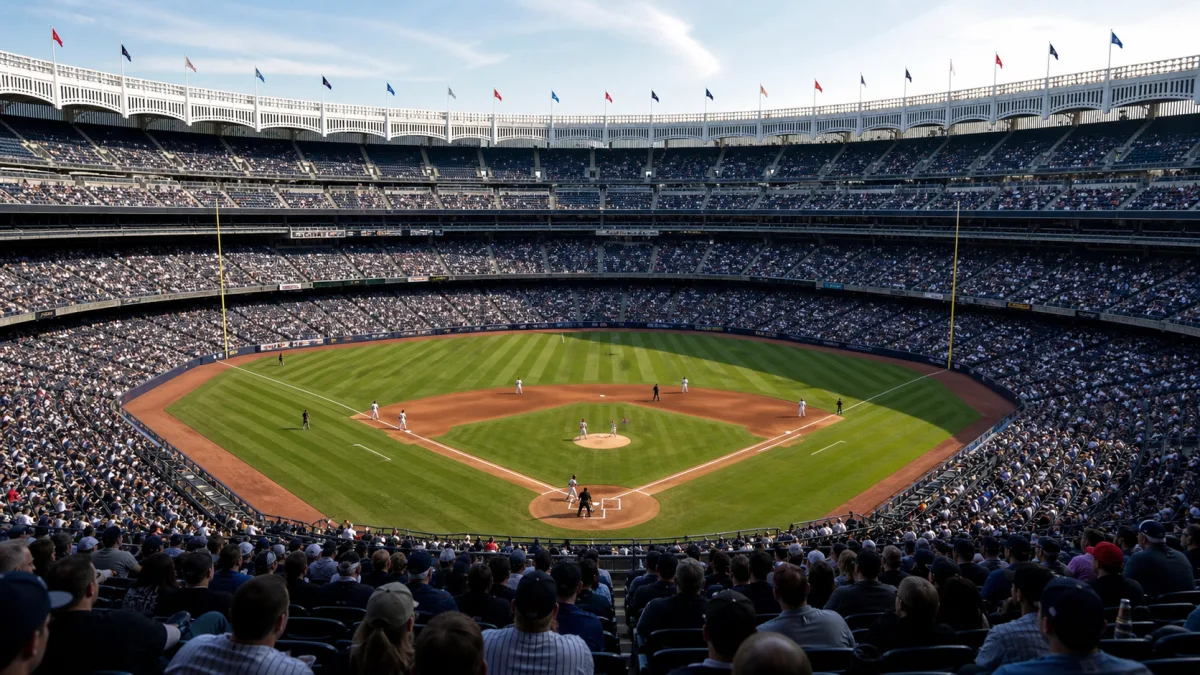
Yankee Stadium holds 46,543 spectators for baseball, according to MLB’s current 2026 ballpark guide. That makes it one of Major League Baseball’s largest active venues, though it remains well below 56,000-seat Dodger Stadium.
The number is for the current stadium’s Yankees layout. New York City FC soccer matches, concerts and college football games rearrange the field and close or open different areas, so they do not share one fixed capacity.
Yankee Stadium capacity at a glance
| Use or figure | Capacity | What it means |
|---|---|---|
| Current Yankees baseball | 46,543 | MLB’s official 2026 listing |
| Older baseball listing | 46,537 | Previous seat-inventory figure |
| NYCFC soccer | Around 30,000 | Match-specific sections of the baseball bowl |
| Concert | Event-specific | Stage removes seats; field adds places |
| College football | Event-specific | Temporary gridiron and operational zones |
| Original Yankee Stadium | Historical and variable | A separate building closed in 2008 |
Capacity is not attendance. A sold-out game can report a slightly different crowd because of standing areas, suites, complimentary tickets and operational holds. Likewise, an announced concert crowd does not tell you how many permanent baseball seats exist.
Is the capacity 46,543 or 46,537?
46,543 is the current answer. MLB’s guide, updated for the 2026 season, publishes that number. The 46,537 figure appears in recent guides and databases because it was the accepted inventory before the latest small adjustment.
Ballpark capacities are not carved into concrete. Teams replace rows with gathering decks, alter premium areas, add accessible positions and reclassify standing spaces. A six-seat difference is the sort of inventory revision that can happen without construction visible from the field.
For current comparisons, SportsLook uses 46,543. Historical articles quoting 46,537 were not necessarily wrong when written; they should simply not outrank a newer first-party source.
How large is Yankee Stadium among MLB parks?
Yankee Stadium is fifth in our current largest baseball stadiums ranking, behind Dodger Stadium, Chase Field, T-Mobile Park and Coors Field. It is still large by modern MLB standards, when clubs increasingly favor intimate bowls and premium social spaces over 60,000-seat designs.
The gap to the leader is 9,457 seats. Our separate Dodger Stadium capacity guide explains why Los Angeles remains the only active MLB park at 56,000.
Yankee Stadium feels especially tall because multiple decks rise steeply around a compact Bronx site. Its physical presence can seem larger than its seat count suggests.
Capacity for Yankees games
The baseball bowl wraps from the right-field bleachers around home plate to left-center field. The standard configuration keeps center field open for the batter’s eye, Monument Park and social spaces rather than filling every possible footprint with seats.
Premium suites and clubs account for a significant portion of the lower and middle levels. The stadium can announce a packed house without every conventional row being occupied, because attendance also reflects suite guests and other valid admissions.
Postseason and rivalry games do not permanently increase the building. Additional standing inventory or operational releases may change the crowd for one night, but 46,543 remains the baseline capacity.
NYCFC soccer capacity and field layout
New York City FC converts the ballpark for soccer. The pitch sits across the baseball field rather than matching the diamond’s geometry, producing an unusual asymmetrical map. Some baseball sections are too far from the touchline or have poor angles and may stay closed.
Published soccer capacity is commonly around 30,000, but the number available changes by match. Opponent demand, supporter segregation, broadcast platforms and temporary field structures all affect sales.
The club’s live map is more useful than a generic figure. Fans seeking a tactical view should prioritize the long sides of the soccer pitch, not automatically assume a premium baseball section will face halfway.
NYCFC’s new soccer-specific stadium is intended to end this conversion arrangement once it opens. Until then, scheduling conflicts can also move selected home matches elsewhere.
Concert capacity at Yankee Stadium
Concerts trade baseball inventory for field capacity. An end-stage production closes seats behind and beside the stage but places reserved chairs or standing spectators across the outfield and infield cover.
An in-the-round show can open more of the bowl. A huge touring set can do the opposite. Sound towers, camera platforms, fire lanes and sightline holds further change the total.
There is no reliable universal concert capacity. Use the exact ticket map and check whether “floor” means an assigned chair or general admission. Elevated lower-bowl seats facing an end stage often provide a cleaner complete view than the rear of a flat field section.
College football and other configurations
Yankee Stadium hosts the Pinstripe Bowl and occasional college games. A temporary football field fits across the outfield, while team areas, goalposts and sideline runoffs replace baseball uses. Sightlines are inevitably less uniform than at a purpose-built football stadium.
Seats near the baseball infield may face one end or sit at an angle to the gridiron. Check the football chart before buying rather than choosing by familiar baseball section reputation.
The same principle applies to boxing, ceremonies and private events: the building’s official baseball capacity is context, not a promise about the event layout.
Seating levels explained
The stadium uses several named tiers:
- Field Level: closest to the diamond, including high-priced premium areas behind home plate and the dugouts.
- Main Level: a useful middle elevation with broad infield views.
- Terrace and Grandstand: higher sections where central positions give strong value and complete field geometry.
- Bleachers: outfield seating with a louder, more communal atmosphere; traditional bench-style areas offer less back support.
- Suites and clubs: premium products with separate amenities that depend on the exact ticket.
Section numbers run around the bowl, but a map for soccer or a concert can use the same physical section very differently.
Best seats for baseball
Behind home plate at moderate elevation is the classic all-field view. You see pitch movement, defensive positioning and both foul lines, though these are among the most expensive tickets.
Seats between first and third base balance proximity and perspective. Very low rows near a dugout feel intimate but can put protective netting and people in the sightline. Upper central sections are farther away yet make the entire diamond easy to read.
The right-field bleachers deliver tradition and atmosphere, especially near the Bleacher Creatures in Section 203. They are less comfortable for anyone who needs a supportive chair and less suited to studying pitches.
For afternoon games, sun exposure changes by section and time. Check a recent shade map for the exact date rather than relying on a general “third-base side” rule.
Monument Park and the Yankees Museum
Monument Park sits beyond center field and honors retired numbers and franchise figures. It is generally open before games and closes well before the final out, often when entry queues are longest. Arrive early if it is a priority.
The Yankees Museum is on the Main Level near Section 210 and remains open later into games under normal policy. Its artifacts and signed-ball wall make it easier to visit after first pitch, though hours can change.
These attractions do not alter the capacity question, but they affect which gate and arrival time make sense. A cheap seat and an early tour can be a better first visit than spending the whole budget on proximity.
Location and public transportation
Yankee Stadium is at 1 East 161st Street in the Bronx. The subway is the simplest option for most visitors: the 4 and D trains serve 161st Street–Yankee Stadium, with B service available on weekdays under the normal schedule.
Metro-North serves Yankees–East 153rd Street, useful from Grand Central and northern suburbs on event days. City buses also reach the area.
Driving means Major Deegan Expressway traffic and paid garages. A late arrival can turn a short final mile into the longest part of the trip. Check current MTA service changes and leave extra time for security.
Accessibility, bags and entry
Accessible and companion seating is distributed around the stadium, but exact inventory changes by event layout. Purchase through authorized channels and contact guest relations early if a transfer seat, step-free route or particular view is essential.
Bag dimensions and prohibited-item rules can change between Yankees games and promoter-run events. Review the official A-Z guide on the day of travel. Bringing a smaller compliant bag speeds screening.
Four primary pedestrian gates serve different sides of the stadium. Match the gate to your seat or planned first stop; walking around the exterior after entering is less convenient than arriving on the right side.
Current stadium versus the original Yankee Stadium
The present ballpark opened in 2009. It borrowed the limestone exterior, rooftop frieze and historical atmosphere of the original, but it is a separate building across East 161st Street. The Steinbrenner family controls the Yankees through Yankee Global Enterprises, while the stadium itself uses a New York City public ownership and lease structure.
The original opened in 1923, closed for a major mid-1970s renovation and hosted its final Yankees season in 2008. Its capacity changed many times and should not be attached to today’s stadium.
The old site’s footprint is now part of Heritage Field and Macombs Dam Park. That is why searches can produce much larger historical numbers without contradicting the current 46,543 figure.
For modern planning, remember 46,543 for Yankees baseball. Treat 46,537 as an older inventory number and use the live map for soccer, concerts or football. Browse more venue comparisons in the SportsLook stadiums hub.
Frequently asked questions
What is the capacity of Yankee Stadium?+
MLB's current 2026 ballpark guide lists Yankee Stadium at 46,543 for baseball. Event-specific configurations can offer a different number of tickets.
Why do some sources say Yankee Stadium holds 46,537?+
That is a recent but older baseball inventory figure. Small changes to seats and social spaces can move capacity by a few places; MLB's current guide lists 46,543.
What is Yankee Stadium's soccer capacity?+
New York City FC uses only part of the baseball bowl, and the available inventory changes by match. Published soccer figures are around 30,000, but the live NYCFC map is the reliable guide.
How many people can attend a concert at Yankee Stadium?+
Concert capacity varies with the stage and floor setup. Some baseball seats close behind the stage while temporary field seats or standing admission add capacity.
Is this the original Yankee Stadium?+
No. The current stadium opened in 2009 across East 161st Street from the original, which operated from 1923 through 2008 apart from its mid-1970s renovation closure.
Where is Yankee Stadium?+
It is at 1 East 161st Street in the Bronx, New York, beside the 161st Street–Yankee Stadium subway station.
Sources
Related stadiums & arenas guides
View all →
Levi's Stadium Capacity: 49ers, Concerts and Soccer
Levi's Stadium holds 68,500 for 49ers games and expands to 75,000. See World Cup, concert and seating capacities explained.
MetLife Stadium Capacity: NFL, Concerts and Soccer
MetLife Stadium holds 82,500 for NFL games. See its World Cup conversion, concert capacities, seating levels and Giants-Jets setup.
SoFi Stadium Capacity: NFL, Concerts and Soccer
SoFi Stadium holds 70,240 for football and can expand toward 100,000. See concert, World Cup and seating capacities explained clearly.
Rose Bowl Capacity: Football, Soccer and Concerts
The Rose Bowl lists a 90,888 capacity, but event inventories vary. See seating, concert layouts, record crowds and its SoFi comparison.

Allianz Stadium Sydney Capacity: How Many Seats Are There?
Allianz Stadium Sydney has a published capacity of 42,500 seats. Learn who plays there, when it opened and why event capacity can vary.
Allegiant Stadium Capacity: How Many People Can It Hold?
Allegiant Stadium holds 65,000 for Raiders games and can expand to 71,835. Compare football, concert and soccer configurations.