Dodger Stadium Capacity: Baseball, Concerts and Seats
On this page13
- 01Dodger Stadium capacity at a glance
- 02Is Dodger Stadium exactly 56,000 seats?
- 03Why it is MLB’s largest active ballpark
- 04Baseball game capacity and attendance
- 05Dodger Stadium concert capacity
- 06Dodger Stadium seating levels
- 07Best seats for baseball
- 08Best seats for concerts
- 09Field dimensions and capacity
- 10Capacity changes since 1962
- 11How old is Dodger Stadium?
- 12Season attendance records
- 13Accessibility, parking and arrival
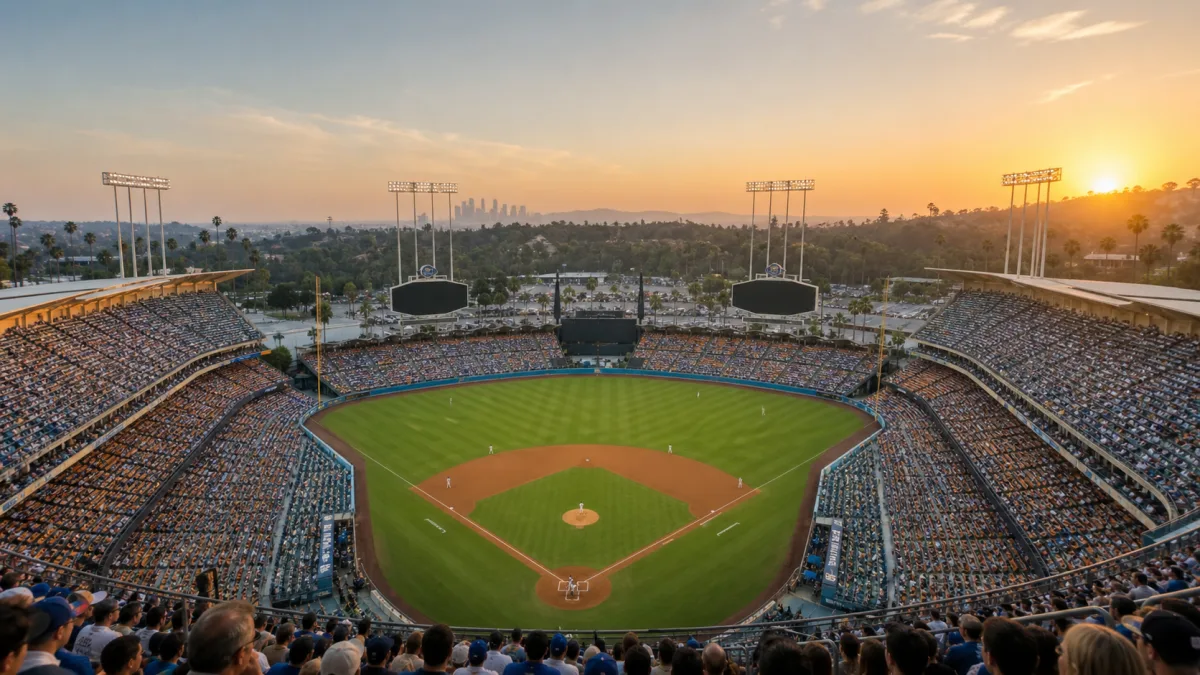
Dodger Stadium’s official capacity is 56,000, the largest listed capacity among active Major League Baseball ballparks.
That number is best understood as the club’s licensed and comparison figure. Renovations have added tables, accessible spaces and new seating products, and team officials have not released a precise current chair count. For a particular game or concert, the sellable inventory can be lower than 56,000.
Dodger Stadium capacity at a glance
| Measure | Capacity / attendance | Meaning |
|---|---|---|
| Official baseball capacity | 56,000 | Dodgers and MLB reference figure |
| 2025 average home attendance | 49,537 | Average across 81 regular-season home dates |
| 2025 season attendance | 4,012,470 | Cumulative total, not one-game capacity |
| 1973 regular-season crowd record cited historically | 55,185 | Dodgers vs Giants |
| 1975 Elton John concerts | 100,000+ combined | Two sold-out shows, not one crowd |
Use 56,000 when comparing ballparks. Use the live seat map when purchasing, because sponsor holds, media positions, premium tables and production equipment change the public inventory.
Is Dodger Stadium exactly 56,000 seats?
Probably not in the literal sense of 56,000 identical fixed chairs. The figure has remained remarkably stable since opening, but the seating bowl has not.
Renovations converted rows into wider box and table products, added accessible platforms, altered dugout and club spaces and rebuilt center-field areas. Janet Marie Smith, the executive responsible for major upgrades, told the Society for American Baseball Research that the precise current number was not being supplied, while exit, restroom and concession capacity continued to meet the 56,000 standard.
That makes 56,000 the correct public answer without pretending it is a fresh manual count. It functions as a certified design and comparison capacity, much like a venue may list a round number while releasing fewer tickets for an individual date.
Why it is MLB’s largest active ballpark
Dodger Stadium leads current MLB venues by listed baseball capacity. The gap is substantial because most modern ballparks favor premium clubs, suites, wider concourses and smaller bowls in the 35,000 to 45,000 range.
| Ballpark | Listed baseball capacity |
|---|---|
| Dodger Stadium | 56,000 |
| Coors Field | About 50,000 |
| Yankee Stadium | About 46,500 |
| Oakland Coliseum | No longer an active MLB home |
| Angel Stadium | About 45,500 |
The Oakland Coliseum historically listed more than 56,000 in some configurations, but the Athletics left after 2024. It no longer displaces Dodger Stadium in a ranking of active MLB homes.
Our largest baseball stadiums guide compares the league using each venue’s standard baseball configuration rather than concert or standing-room maximums.
Baseball game capacity and attendance
Capacity is the potential inventory; attendance is what a particular game or season reports. The Dodgers routinely lead MLB attendance without selling all 56,000 places at every date.
In 2025, the club drew 4,012,470 regular-season fans, averaging 49,537 per home game. The season total crossed four million because it adds attendance across 81 dates. It does not mean four million people entered at once or that unique individuals were counted only once.
Announced attendance may reflect tickets distributed rather than every body scanned through a gate. Premium holds, standing products and postseason media layouts can also push a game’s announced figure above or below the everyday public-seat inventory.
Dodger Stadium concert capacity
There is no single concert capacity. The stage and production determine which seats have a safe, unobstructed view and how much of the baseball field becomes audience space.
| Concert layout | Capacity effect |
|---|---|
| Center-field end stage | Blocks much of the outfield seating behind it |
| Home-plate-facing stage | Changes which baseline and pavilion sections are sellable |
| Center / in-the-round stage | Opens more of the bowl and adds floor admission |
| Reserved floor seats | Adds inventory with aisles and technical zones |
| General-admission field | May add more people, subject to crowd and turf protection plans |
Elton John’s famous 1975 engagement drew more than 100,000 people across two sold-out concerts. It is often repeated without the two-night qualifier, creating an impossible-looking one-show claim. Each night used a concert setup around the 50,000 range. The nearby Rose Bowl capacity guide shows the same distinction between permanent seats and field-based concert crowds in a much larger open bowl.
A current sold-out end-stage show may hold substantially fewer people than a sold-out baseball game. “Sold out” means all tickets released for that production were sold.
Dodger Stadium seating levels
The ballpark’s terraced design connects parking lots near the elevation of the seating deck they serve. Its main inventory is organized as:
- Field Level: closest to the diamond, wrapping from foul pole to foul pole.
- Loge Level: second tier, prized for its balance of height and proximity.
- Club and Suite Level: premium spaces in the middle of the structure.
- Reserve Level: large upper seating tier around the infield and toward the outfield.
- Top Deck: highest seats directly behind home plate.
- Pavilions and center field: outfield seating and social areas beyond the fences.
The official team history describes six parking and seating elevations. That terrain-based approach lets many fans enter near their level rather than climbing from one ground-level concourse.
Best seats for baseball
The best all-around baseball view is usually on the Loge level behind home plate or along an infield baseline. The height makes pitch location, defensive alignment and the full outfield easier to see without feeling remote.
Field-level infield seats provide proximity to players and the speed of the game. Lower rows can have sightlines interrupted by people, netting or dugout structures, so “closest” is not always “clearest.”
Top Deck seats behind home plate are farther away but provide a symmetrical view at a lower price. Pavilion seats offer home-run-ball potential and a direct look toward the infield, with less ability to judge pitch movement.
For day games, sun exposure matters. Shade moves across the park, and an evening seat that is comfortable in April can remain hot during a summer afternoon. Check the date, time and section orientation rather than relying on a universal shade claim.
Best seats for concerts
Ignore the baseball hierarchy until you see the concert stage. An excellent Loge baseball seat can face the side of an end-stage production, while a normally modest outfield or floor location may point directly at the performance.
Floor seats are close but flat. A shorter spectator behind several rows of standing people may see less than someone in an elevated bowl section. Sound and mixing towers can also obstruct seats that look clear on a generic stadium map.
Use the event-specific chart and read limited-view disclosures. Touring productions can change after the first ticket release, so recheck the final map before arrival.
Field dimensions and capacity
The official dimensions are 330 feet down both foul lines, 385 feet to left-center and right-center, and 395 feet to center field. The symmetrical outfield is unusual among ballparks built into constrained urban sites.
Field dimensions do not directly determine seating capacity. Dodger Stadium’s size comes from its continuous multi-level bowl and large outfield pavilions, while its Chavez Ravine site provided room for terraced parking around the structure.
The low outfield fence is 55 inches from each foul pole toward the bullpens, rising to eight feet between the bullpens. Those details affect play, not the 56,000 spectator standard.
Capacity changes since 1962
Dodger Stadium opened on 10 April 1962 after a privately financed $23 million construction project. Its advertised capacity was 56,000 from the start, even as actual seat products evolved.
Major changes have included:
- Replacement of the original colorful seats, then restoration of a 1962-inspired palette.
- Conversion of some baseline rows into wider box seating with tables.
- New clubs, suites, accessible platforms and premium areas.
- Center Field Plaza and connections between previously separated outfield zones.
- Upgraded player facilities and building systems before the 2025 season.
The visual identity remains remarkably intact. That continuity is why the venue can feel both historic and current despite being MLB’s third-oldest active park.
How old is Dodger Stadium?
It opened in 1962, behind only Fenway Park (1912) and Wrigley Field (1914) among active MLB homes. Unlike many multipurpose stadiums of its era, it was designed specifically for baseball and has never required a wholesale replacement of its seating bowl.
The ballpark has hosted ten World Series through 2025. The Dodgers won championships associated with the venue in 1963, 1965, 1981, 1988, 2020, 2024 and 2025, though the 2020 World Series itself was played at a neutral site in Texas.
Age alone does not make it the biggest; its original 56,000-seat ambition and continued demand have allowed the club to preserve a capacity modern projects rarely attempt.
Season attendance records
The Dodgers became the first MLB club to draw more than three million home fans in a season in 1978, when attendance reached 3,347,845. The franchise later made three million routine and surpassed four million in 2025.
| Season | Home attendance | Average per game |
|---|---|---|
| 2023 | 3,837,079 | 47,371 |
| 2024 | 3,941,251 | 48,657 |
| 2025 | 4,012,470 | 49,537 |
These totals measure demand over a season, while capacity measures one configured event. Both matter, but they answer different questions.
Accessibility, parking and arrival
Accessible seating and companion locations are distributed across multiple elevations. Availability varies by price and event, so guests should use the current ticket map and contact the Dodgers for assistance rather than assuming a generic section is accessible.
The stadium has roughly 16,000 parking spaces across 21 terraced lots. That scale does not eliminate congestion: most vehicles share a limited road network through Elysian Park and surrounding neighborhoods.
Confirm the recommended gate and parking level before arrival. Entering near the same elevation as the seat reduces ramps and stairs, one of the original design’s most practical features. Event transit and rideshare procedures can differ from baseball-game operations.
For comparisons, use 56,000 as Dodger Stadium’s official baseball capacity. For a ticket purchase, use the specific game’s or concert’s map. More current venue guides are collected in the SportsLook stadiums hub.
Frequently asked questions
What is Dodger Stadium's seating capacity?+
The Los Angeles Dodgers and MLB officially list 56,000. Renovations have changed the precise number of physical seats, but 56,000 remains the standard licensed and comparison capacity.
Is Dodger Stadium the largest MLB stadium?+
Yes by listed baseball capacity. Its 56,000 places are more than any other active MLB ballpark, although individual game inventory may be lower.
How many people can attend a concert at Dodger Stadium?+
There is no fixed concert number. An end stage closes outfield seats, while floor seating or standing adds people on the field. The artist's stage plan determines the actual inventory.
What are the seating levels at Dodger Stadium?+
The main levels are Field, Loge, Club and suites, Reserve, and Top Deck, with separate outfield pavilion and center-field seating. Terraced parking connects near the elevation of each level.
How old is Dodger Stadium?+
It opened on April 10, 1962. In 2026 it is MLB's third-oldest active ballpark behind Fenway Park and Wrigley Field.
How many fans did the Dodgers draw in 2025?+
The Dodgers drew a franchise-record 4,012,470 regular-season fans in 2025, an average of 49,537 per home game. That season total should not be confused with one-game capacity.
Sources
Related stadiums & arenas guides
View all →
15 Largest Baseball Stadiums in MLB by Capacity (2026)
See the largest MLB stadiums ranked by 2026 baseball capacity, from 56,000-seat Dodger Stadium to the rest of the top 15 ballparks.
Yankee Stadium Capacity: Baseball, Soccer and Concerts
Yankee Stadium holds 46,543 for baseball in 2026. See why older totals differ and how seating changes for soccer, concerts and football.

Allianz Stadium Sydney Capacity: How Many Seats Are There?
Allianz Stadium Sydney has a published capacity of 42,500 seats. Learn who plays there, when it opened and why event capacity can vary.
AT&T Stadium Capacity: Cowboys Seats and 100,000 Max
AT&T Stadium seats 80,000 and expands to 100,000 for major events. See Cowboys, concert and soccer capacities plus seating tips.
Levi's Stadium Capacity: 49ers, Concerts and Soccer
Levi's Stadium holds 68,500 for 49ers games and expands to 75,000. See World Cup, concert and seating capacities explained.
MetLife Stadium Capacity: NFL, Concerts and Soccer
MetLife Stadium holds 82,500 for NFL games. See its World Cup conversion, concert capacities, seating levels and Giants-Jets setup.