Rose Bowl Capacity: Football, Soccer and Concerts
On this page12
- 01Rose Bowl capacity at a glance
- 02Why published Rose Bowl capacities differ
- 03Capacity for UCLA football
- 04Rose Bowl Game seating capacity
- 05Soccer capacity at the Rose Bowl
- 06Rose Bowl concert capacity
- 07Record attendance at the Rose Bowl
- 08Rose Bowl seating layout
- 09What are the best seats?
- 10Rose Bowl versus SoFi Stadium capacity
- 11Is the Rose Bowl one of America’s largest stadiums?
- 12Accessibility and getting to the correct seat
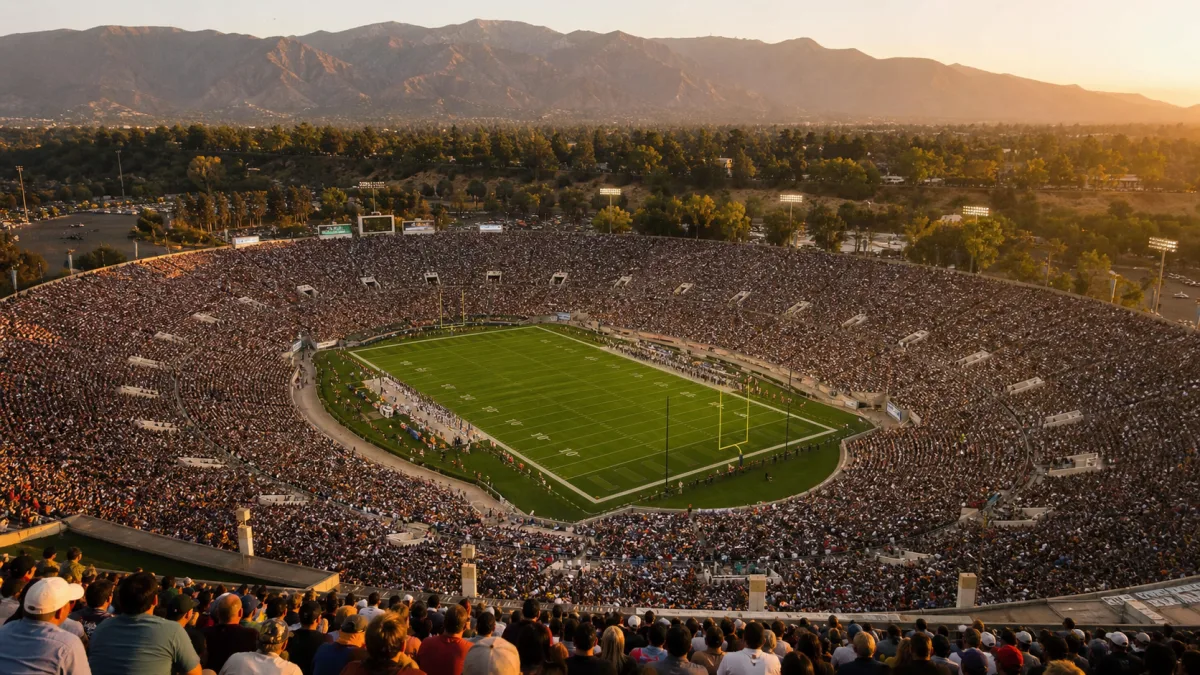
Rose Bowl Stadium’s official history page lists a capacity of 90,888. That is the best headline figure for the physical venue, but it is not the exact number of tickets available for every UCLA game, Rose Bowl Game, soccer match or concert.
The event layout determines the sellable inventory. That is why credible sources also show figures such as 89,105, 88,565 and 91,136—and why old attendance records can exceed 100,000.
Rose Bowl capacity at a glance
| Measure or event | Capacity / attendance | Meaning |
|---|---|---|
| Official stadium capacity | 90,888 | Figure on the venue’s history page |
| Rose Bowl Game official capacity | 89,105 | Published event-specific figure |
| Common current reporting | About 89,000 | Rounded operational reference |
| 1973 Rose Bowl Game | 106,869 | Record football crowd under an older layout |
| 1999 Women’s World Cup final | 90,185 | Landmark soccer attendance |
| 2009 U2 concert | 97,014 | In-the-round concert attendance |
| 2023 Galaxy vs LAFC | 82,110 | Then-record MLS single-game crowd |
Use 90,888 when comparing the building’s stated capacity. Use the ticket map for a particular event, because seats can disappear behind a stage, media platform or safety buffer.
Why published Rose Bowl capacities differ
Capacity is a licensed configuration, not a count carved permanently into the concrete. The Rose Bowl has been renovated repeatedly since opening in 1922, and its century-old bench-style bowl has changed with modern comfort, access and operational rules.
Several factors produce different published figures:
- The Rose Bowl Game has its own media, team and sponsor allocations.
- UCLA may close or hold sections when demand is lower.
- Soccer needs different benches, camera positions and segregation zones.
- Concert stages block seats but floor admission adds people elsewhere.
- Premium clubs, accessible platforms and wider seating reduce old row density.
- Sources may preserve a capacity from before the latest renovation.
An older UCLA facilities page lists 91,136, while recent college-football comparisons often use 88,565. Those numbers describe a source date or event inventory. The venue’s own current history page provides the clearest building-level figure: 90,888.
Capacity for UCLA football
UCLA began playing home football at the Rose Bowl in 1982. The open bowl can physically hold roughly 90,000, but the university does not need to release every section for each opponent.
An announced attendance is also different from turnstile count and capacity. It may reflect tickets distributed rather than every person scanned through a gate. A crowd of 45,000 does not mean half the seats were removed; it means that event used or sold only part of the available inventory.
The distance from UCLA’s Westwood campus to Pasadena has long affected travel and attendance discussions. It does not alter the stadium’s physical capacity, but it helps explain why a huge national-landmark venue can look sparse for an ordinary home game and packed for a marquee matchup.
Rose Bowl Game seating capacity
The annual Rose Bowl Game uses close to the full bowl, with the Tournament of Roses previously citing 89,105 as its official event capacity. Team allotments, bands, media, hospitality and temporary production all occupy space.
Attendance can edge above a nominal capacity if authorized standing positions, suites or temporary inventory are counted. That does not reset the number of permanent seats. Conversely, a sellout can be slightly below 89,105 when operational holds are not released.
The game’s place in college football is exceptional. It has been played at this stadium since 1923, one year after the building opened, and its “Granddaddy of Them All” identity is the source of the generic term “bowl game.”
Soccer capacity at the Rose Bowl
The Rose Bowl was a principal venue for the 1994 men’s World Cup and hosted the final between Brazil and Italy. Five years later, 90,185 watched the United States defeat China on penalties in the Women’s World Cup final, a landmark crowd in women’s sport.
Modern soccer inventory varies with pitch boards, benches, media positions and supporter separation. Recent high-profile crowds include:
- 82,110 for LA Galaxy vs LAFC on 4 July 2023, then an MLS single-game record.
- 70,814 for Real Madrid vs AC Milan later in July 2023.
- More than 80,000 for Paris Saint-Germain vs Atlético Madrid during the 2025 Club World Cup.
None of those figures should replace the stadium capacity. They are event attendances shaped by demand and configuration.
Rose Bowl concert capacity
Concert capacity has the widest range. A large end stage can close an entire end of the bowl, while a center stage opens nearly every section and adds thousands of people on the field.
U2’s 360° Tour drew 97,014 in October 2009. The stage was designed for spectators around it, and floor admission pushed the crowd above the number of permanent seats. A conventional stage facing one direction may reduce usable seating to around 60,000 or lower, depending on production size.
| Layout | Typical effect |
|---|---|
| End stage | Blocks seats behind the production and lowers capacity |
| In-the-round stage | Opens most of the bowl and can approach or exceed football capacity |
| Reserved floor | Adds seats but requires aisles and technical space |
| General-admission floor | May add more people, subject to safety limits |
A “sold-out Rose Bowl concert” therefore has no universal crowd size. It means all seats and floor tickets released for that performance were sold.
Record attendance at the Rose Bowl
The best-known football record is 106,869 for USC’s 42–17 victory over Ohio State on 1 January 1973. Several Rose Bowl Games in that era drew more than 100,000.
Those crowds were possible because spectators occupied denser bench arrangements before later renovations added wider seating, premium spaces, access aisles and modern safety provisions. Historical attendance is a record of who entered on one day, not proof that 106,869 tickets could be sold under today’s certificate.
Other landmark crowds include the 1999 Women’s World Cup final’s 90,185 and U2’s 97,014 concert audience. Each used a different field and seating plan, reinforcing why records should be labeled by event type.
Rose Bowl seating layout
The stadium is one continuous elliptical bowl rather than stacked modern decks. Seating is divided into numbered sections around the field, with tunnels entering partway up the rows.
For football, lower midfield seats provide proximity, but higher rows around midfield offer a clearer view of formations and both end zones. Low end-zone seats feel close to scoring plays yet make action at the opposite goal line harder to judge.
The bowl’s shallow historic geometry means the highest rows sit far from the field compared with a steep modern stadium. They compensate with panoramic views of the San Gabriel Mountains and the full playing surface.
What are the best seats?
For UCLA or the Rose Bowl Game, central sections between the 20-yard lines are the conventional premium choice. Rows above the lowest portion of the bowl avoid sideline obstructions and provide better depth perception.
For soccer, a position near halfway makes tactics easiest to follow. For concerts, ignore football conventions and face the stage: the best section changes completely with an end-stage, runway or center-stage setup.
Buy from the event-specific map, not a generic stadium diagram. Production kills and limited-view warnings are more useful than the section’s reputation at another event.
Rose Bowl versus SoFi Stadium capacity
| Feature | Rose Bowl | SoFi Stadium |
|---|---|---|
| Standard stated capacity | 90,888 | 70,240 |
| Opened | 1922 | 2020 |
| Roof | None | Translucent canopy |
| Primary regular use | UCLA, Rose Bowl Game | Rams, Chargers |
| Expandable special-event claim | Layout-dependent | Up to 100,000 |
| Premium inventory | Limited by historic design | 13,000+ premium seats, 260+ suites |
The Rose Bowl has about 20,648 more standard places than SoFi. SoFi is physically larger in floor area, much newer and built around premium hospitality, flexible production and a shared NFL schedule. Its capacity guide explains why its 100,000 expansion claim is not the everyday number.
SoFi hosted Los Angeles matches at the 2026 World Cup even though the Rose Bowl has more seats and deeper World Cup history. The complete 2026 World Cup stadium guide records the event-specific capacities used across all 16 venues. Modern team facilities, media compounds and tournament operations mattered alongside raw capacity.
The Rose Bowl’s soccer history also belongs beside the current biggest soccer stadiums ranking, which uses regular listed capacity rather than one-off tournament crowds.
Is the Rose Bowl one of America’s largest stadiums?
Yes. At 90,888 it ranks below the group of 100,000-plus college venues led by Michigan Stadium, Beaver Stadium, Ohio Stadium, Kyle Field, Tiger Stadium and Neyland Stadium, but above every active NFL stadium in standard seating.
Its precise national rank moves when college venues renovate or adjust certificates. The broader largest stadiums in the United States ranking applies one standard-capacity method across sports.
Accessibility and getting to the correct seat
Accessible seating and companion locations are distributed around the stadium, but century-old geometry and a large outdoor campus can make travel distances significant. Guests should arrange assistance before the event and confirm the recommended gate for their section.
Parking and shuttle plans change with crowd size. The stadium sits in the Arroyo Seco rather than beside a major rail station, so arrival time matters for both driving and remote-shuttle users. The final climb to high rows can also be substantial.
For a simple comparison, remember 90,888 as the official physical capacity, roughly 89,000 for many football-event inventories, and a completely event-dependent number for concerts. The SportsLook stadiums hub keeps these configuration differences explicit across venues.
Frequently asked questions
What is the Rose Bowl Stadium capacity?+
The stadium's official history page lists 90,888. Event-specific sellable capacity may be lower; the Rose Bowl Game has previously published an official event capacity of 89,105.
Why do some sources say the Rose Bowl holds 88,565 or 91,136?+
Different sources use different dates and configurations. Renovations, wider seats, premium and media areas, temporary holds and the particular event licence all change how many tickets can be sold.
What is the largest crowd ever at the Rose Bowl?+
The best-known football record is 106,869 for USC against Ohio State at the 1973 Rose Bowl Game. That crowd used an older, denser seating configuration that is not available today.
How many people can attend a Rose Bowl concert?+
It depends on the stage and floor plan. U2's 360-degree production drew 97,014 in 2009, while an end-stage concert can block a large part of the bowl and hold far fewer.
Is the Rose Bowl bigger than SoFi Stadium?+
By standard permanent seating, yes: the Rose Bowl lists 90,888 versus SoFi's standard 70,240. SoFi can expand for selected events and has much more premium and modern production infrastructure.
Who plays home games at the Rose Bowl?+
UCLA football has used the Rose Bowl as its home field since 1982. The stadium also hosts the annual Rose Bowl Game and major one-off soccer, concert and festival events.
Sources
Related stadiums & arenas guides
View all →
Levi's Stadium Capacity: 49ers, Concerts and Soccer
Levi's Stadium holds 68,500 for 49ers games and expands to 75,000. See World Cup, concert and seating capacities explained.
MetLife Stadium Capacity: NFL, Concerts and Soccer
MetLife Stadium holds 82,500 for NFL games. See its World Cup conversion, concert capacities, seating levels and Giants-Jets setup.
SoFi Stadium Capacity: NFL, Concerts and Soccer
SoFi Stadium holds 70,240 for football and can expand toward 100,000. See concert, World Cup and seating capacities explained clearly.
Yankee Stadium Capacity: Baseball, Soccer and Concerts
Yankee Stadium holds 46,543 for baseball in 2026. See why older totals differ and how seating changes for soccer, concerts and football.

Biggest Stadiums in Germany: football capacity and standing-room context
Germany’s largest football grounds explained with the standing-room and international-match distinction made explicit.

Largest Football Stadiums in England: the current capacity guide
A verified comparison of England’s biggest football grounds, separating published capacity from match-day availability.