AT&T Stadium Capacity: Cowboys Seats and 100,000 Max
On this page13
- 01AT&T Stadium capacity at a glance
- 02Why 80,000 and 100,000 both appear
- 03Cowboys capacity and Party Pass tickets
- 04Concert capacity changes with the stage
- 05Soccer and World Cup configurations
- 06Basketball, wrestling and record crowds
- 07Seating levels explained
- 08Best seats for football
- 09Best seats for concerts
- 10Retractable roof, doors and climate
- 11Location, parking and transport
- 12Accessibility and entry planning
- 13How AT&T compares with other NFL stadiums
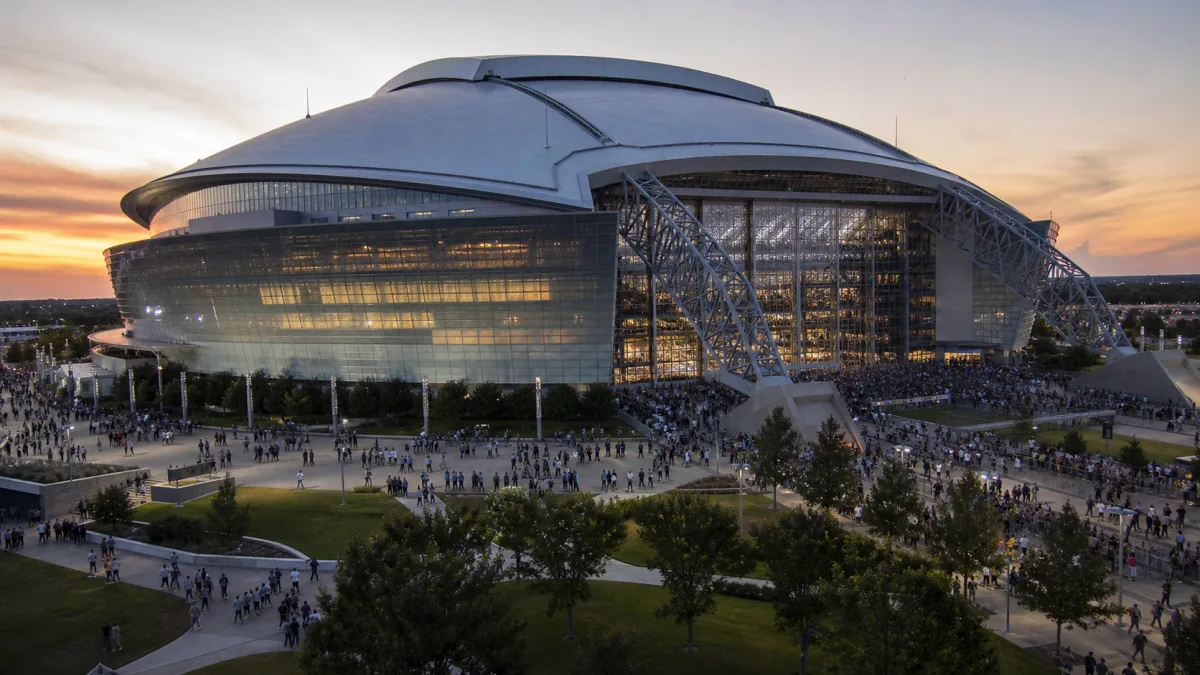
AT&T Stadium seats 80,000 people in its standard Dallas Cowboys configuration. For selected events, the building can expand to 100,000 by adding standing-room and other event-specific inventory.
Both numbers are official, but they answer different questions. Eighty thousand is the figure for comparing permanent NFL capacities. One hundred thousand describes the full venue when organizers activate its flexible spaces.
AT&T Stadium capacity at a glance
| Configuration or record | Capacity / attendance | Meaning |
|---|---|---|
| Standard Cowboys football | 80,000 | Normal seated capacity |
| Expanded special event | Up to 100,000 | Seats plus standing and temporary inventory |
| 2009 Cowboys vs Giants | 105,121 attendance | Opening-season crowd with extensive standing room |
| 2010 NBA All-Star Game | 108,713 attendance | Court, floor and expanded configuration |
| Concert | Event-specific | Stage removes seats; floor adds places |
| International soccer | Event-specific | Pitch and operations alter available inventory |
Those record crowds do not mean the building contains 108,713 permanent chairs. Attendance counts everyone admitted for one event. Seating capacity counts seats in a defined layout.
Why 80,000 and 100,000 both appear
The NFL lists AT&T Stadium at 80,000, expandable to 100,000 for special events. The City of Arlington publishes the same figures. That makes 80,000 the clean answer to “How many seats are in AT&T Stadium?”
Expansion relies on broad standing decks behind the end zones. These tickets are commonly called Party Passes. Temporary field positions can add more capacity when an event does not need the entire football surface.
Organizers still need space for stages, television compounds, camera platforms, teams, media, accessible viewing areas, clear aisles and emergency exits. A production-heavy sellout can report fewer than 80,000, while a purpose-built configuration can pass 100,000.
Cowboys capacity and Party Pass tickets
For a normal Cowboys game, the bowl is based on 80,000 seats. High-demand games go higher when standing decks open. Party Pass holders enter without an assigned chair and compete for positions along the rails.
That product lowers the price of entry and produces a lively end-zone atmosphere, but it is not equivalent to a reserved seat. The front row at a rail may have a usable field view; several people behind it may see more of the enormous video board than the turf. Arriving early matters.
AT&T ranks behind 82,500-seat MetLife when venues are compared by permanent seating, yet it becomes the NFL’s largest crowd environment when fully expanded. Our largest NFL stadiums table deliberately keeps those measures separate.
Concert capacity changes with the stage
There is no fixed concert number. An end-stage production closes the sections behind it and often blocks some side seats, but it places thousands of people on the field. A center or in-the-round stage can reopen more of the bowl and use nearly the entire floor.
A spectacular stage may consume enough space to hold fewer people than a football game. A compact production with standing floor admission can approach the expanded range.
Check the artist-specific map for a reserved seat versus general admission, limited-view labels, sound towers, runways and the position of the center-hung display. A generic football chart cannot tell you whether your concert ticket faces the performance.
Soccer and World Cup configurations
Soccer needs a wider playing area and runoff beyond the touchlines. Field suites, advertising boards, camera positions and team areas may change or disappear. FIFA tournament maps also use dedicated hospitality and media zones and do not simply sell the Cowboys’ standing-room plan.
AT&T Stadium operated as Dallas Stadium during the 2026 World Cup because tournament naming rules removed the sponsor. It was the same Arlington building, not a second venue.
For soccer, a central seat with moderate elevation gives the best tactical view. Lower corners bring you close to goalmouth action but flatten the perspective at the far end. Use the competition’s live chart rather than applying the 100,000 special-event ceiling.
Basketball, wrestling and record crowds
A basketball court occupies only a fraction of the football floor, leaving room for temporary seating. That helped the 2010 NBA All-Star Game report 108,713 spectators. Wrestling combines a central ring, floor chairs and a large entrance stage; motocross and rodeo use still different footprints.
Each event can announce a sellout total that has little relevance to a Cowboys game. The honest rule is to use 80,000 for standard capacity, 100,000 as the official expanded maximum and individual attendance only for the event it describes.
Seating levels explained
AT&T Stadium has several public and premium tiers rather than one lower and one upper bowl:
- 100 level: lower bowl, with premium club blocks along the sidelines.
- 200 level: elevated views plus club and suite areas.
- 300 level: intermediate inventory and premium products.
- 400 level: steep upper deck with a broad full-field perspective.
- End-zone platforms: standing Party Pass zones for selected games.
- Suite levels: roughly 380 luxury suites across the building.
Club access belongs to the exact ticket product. Sitting near a lounge or buying a concert seat in a football club section does not automatically include every game-day benefit.
Best seats for football
Midfield seats at moderate elevation give the most balanced view. Lower sidelines feel close to the players, but very low rows can make it harder to see over the bench and follow action on the far side.
Upper central sections are distant, though the steep rake provides a clean tactical angle. The giant display makes replays unusually easy to follow. Some spectators find themselves watching it more than the field, so decide whether atmosphere, proximity or a direct all-field view matters most.
End-zone seats excel when a drive approaches your side and compress depth at the opposite goal line. Party Pass is best understood as admission and atmosphere, not a guaranteed unobstructed spot.
Best seats for concerts
For an end-stage show, elevated lower-bowl sections facing the stage usually provide the safest complete view. Floor seats improve proximity but put spectators at nearly the same height, where people or production equipment can block sightlines.
Side-stage blocks may be good value if the artist uses a long runway. They can also hide the main visual production. Read every limited-view disclosure.
At an in-the-round show, central floor locations feel immersive while the lower bowl makes the whole production easier to see. The best choice depends on whether you value closeness, complete staging or a guaranteed chair.
Retractable roof, doors and climate
AT&T Stadium has a retractable roof. Two large roof panels open along the building’s long axis. The huge glass end-zone doors also open, but they are a separate feature rather than part of the roof.
The enclosed stadium is climate-controlled, a major advantage during Texas heat or storms. Roof status can change with weather and operations, so check the event-day notice rather than assuming it will be open.
The center-hung video board shapes the view from almost every section. It can move vertically for certain productions, although its scale still limits unusually tall event structures.
Location, parking and transport
AT&T Stadium is at 1 AT&T Way in Arlington, Texas, between Dallas and Fort Worth. It is not in downtown Dallas. A hotel marketed as “Dallas” may be inconvenient once event traffic is added.
The surrounding entertainment district includes Globe Life Field, Texas Live! and Six Flags Over Texas. Buy parking in advance, match the lot to your recommended gate and leave time for security. Overlapping events can change road controls.
Public transit is less direct than at many urban stadiums. Shuttles and rideshare pickup plans vary and may require a long post-event walk. Use the current arrival guide, not an old map saved from another event.
Accessibility and entry planning
Wheelchair and companion positions are spread across levels, with elevators and accessible routes serving the stadium. A concert stage or tournament platform can change availability, so guests with specific transfer or sightline needs should book early through an authorized seller.
Bag rules usually follow the NFL clear-bag policy for Cowboys games, but concert promoters may set different limits. Confirm the individual event rules. Save mobile tickets to your phone wallet before reaching the crowded gate.
The Cowboys are controlled by Jerry Jones and his family. Our guide to who owns the Dallas Cowboys explains that ownership separately from the stadium arrangement.
How AT&T compares with other NFL stadiums
| Stadium | Standard capacity | Expanded capacity |
|---|---|---|
| MetLife Stadium | 82,500 | Event-specific |
| AT&T Stadium | 80,000 | 100,000 |
| SoFi Stadium | 70,240 | About 100,000 |
| Levi’s Stadium | 68,500 | 75,000 |
| Allegiant Stadium | 65,000 | About 71,835 |
AT&T is not first by fixed seats, but few venues match its expansion range. Use 80,000 when comparing permanent football capacity and up to 100,000 for the official special-event ceiling. Then use the live map for the ticket you will actually buy. More comparisons are in the SportsLook stadiums hub.
For like-for-like venue details, compare the enclosed Allegiant Stadium capacity, the expandable SoFi Stadium configuration and the open-air Levi’s Stadium capacity.
Frequently asked questions
How many seats are in AT&T Stadium?+
AT&T Stadium has a standard seating capacity of 80,000. It can expand to 100,000 for selected special events with standing-room and event-specific inventory.
Can AT&T Stadium hold 100,000 people?+
Yes, but 100,000 is an expanded event capacity rather than 100,000 assigned permanent seats. Party Pass areas and temporary or floor positions make the difference.
What is the capacity for a Cowboys game?+
The standard Cowboys configuration is 80,000. High-demand games can admit more when standing-room Party Pass inventory is released.
What is AT&T Stadium's concert capacity?+
It varies. An end stage removes bowl seats but the floor adds places; an in-the-round setup may use more of both. Check the artist's live map.
Does AT&T Stadium have a retractable roof?+
Yes. The roof panels can open, and the giant end-zone glass doors can also open. They are separate moving features.
Is AT&T Stadium in Dallas?+
No. It is at 1 AT&T Way in Arlington, Texas, between Dallas and Fort Worth.
Sources
Related stadiums & arenas guides
View all →
Allianz Stadium Sydney Capacity: How Many Seats Are There?
Allianz Stadium Sydney has a published capacity of 42,500 seats. Learn who plays there, when it opened and why event capacity can vary.
Optus Stadium Capacity: Perth’s 60,000-Seat Venue
Optus Stadium capacity: 60,000 seats, with the source scope, event configuration and current ticketing caveats explained.
Allegiant Stadium Capacity: How Many People Can It Hold?
Allegiant Stadium holds 65,000 for Raiders games and can expand to 71,835. Compare football, concert and soccer configurations.
Levi's Stadium Capacity: 49ers, Concerts and Soccer
Levi's Stadium holds 68,500 for 49ers games and expands to 75,000. See World Cup, concert and seating capacities explained.
MetLife Stadium Capacity: NFL, Concerts and Soccer
MetLife Stadium holds 82,500 for NFL games. See its World Cup conversion, concert capacities, seating levels and Giants-Jets setup.
SoFi Stadium Capacity: NFL, Concerts and Soccer
SoFi Stadium holds 70,240 for football and can expand toward 100,000. See concert, World Cup and seating capacities explained clearly.