How Long to Build a Stadium: 26 Months or 12 Years
On this page7
AT&T Stadium took 26 months. Croke Park took twelve years.
Both answers are correct, and the gap between them has almost nothing to do with engineering.
New builds, on a clear site
| Stadium | Construction time |
|---|---|
| AT&T Stadium | 26 months |
| Emirates Stadium | 29 months |
| Allegiant Stadium | 31 months |
| SoFi Stadium | ~4 years |
The general range for a new stadium is 26 months to three and a half years.
Allegiant Stadium — $1.9 billion, 1.8 million square feet — was completed on time in 31 months. SoFi Stadium ran from November 2016 to September 2020, nearly four years, for the NFL’s largest indoor-outdoor venue.
Two NFL stadiums in the same era, seventeen months apart in build time. That gap is complexity, not competence: SoFi is a far more ambitious structure than a conventional enclosed bowl.
The other kind of project
Now the same question, asked about grounds that could not close.
| Project | Time |
|---|---|
| Croke Park | Four phases, twelve years |
| Anfield | 16,000 seats across thirteen years |
| Camp Nou | Rebuild in progress, overran |
| New Trafford (proposed) | ~5 years expected |
Croke Park was rebuilt across four phases over twelve years without missing an All-Ireland final, as our guide to Croke Park capacity sets out. Anfield went from about 45,000 to 61,000 through two stand rebuilds completed in 2016 and 2023/24 — covered in Anfield capacity.
Neither club stopped playing. That is the entire explanation.
A phased rebuild is not slower construction. It is construction interrupted by a fixture list, done in pieces small enough that the rest of the ground stays certified and safe, in windows dictated by a season rather than a critical path.
Barcelona is attempting it at the largest scale yet, and the Camp Nou rebuild has overrun with usable capacity reduced during the works.
Why United are moving rather than rebuilding
This is the clearest illustration of the trade-off in the game right now.
Manchester United’s proposed 100,000-seat ground at an estimated £2 billion is expected to take about five years, on 25 acres secured in June 2026 — roughly 350 metres from the existing ground. United would keep playing at Old Trafford throughout, as our guide to Old Trafford capacity sets out.
Liverpool chose the opposite: rebuild in place, thirteen years, roughly $10,300 a seat on the Anfield Road Stand against United’s projected ~£20,000 a seat.
Building next door is faster and more expensive. Building in place is cheaper and takes a decade. Neither club made an obviously wrong call; they answered different questions about site, cost and time.
Construction is the short part
The single most misleading thing about every timeline on this page is that it measures construction only.
Before the first excavator arrives there is site acquisition, planning consent, financing and design. Those stages routinely take as long as the build, and none of them appears in “26 months”.
United’s 25 acres were secured in June 2026 for a ground expected to open around five years after construction starts. The proposal existed long before the land did.
When a club says a stadium will take five years, ask five years from what.
The order of work
Construction runs in a fixed sequence: excavation → foundations → enclosure → infrastructure and fit-out → playing surface.
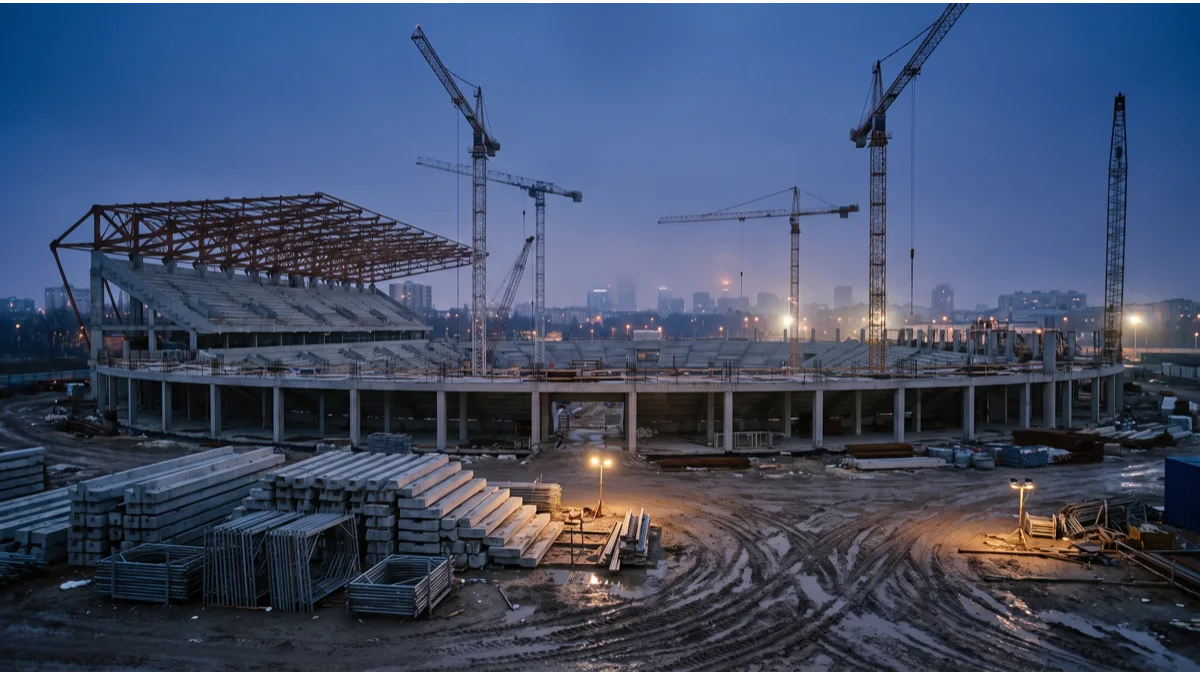
The pitch goes in near the end. That is why a stadium can look essentially finished from the outside for months while remaining unable to host anything — and why photographs of a completed-looking bowl are a poor guide to an opening date.
Timelines are also built with cushion for weather, ground conditions and design changes. A project reported as “on time”, like Allegiant’s 31 months, means it hit a schedule that already contained that allowance.
What it buys
Time and money track each other here. Our ranking of the most expensive stadiums covers what the largest budgets deliver, and our guide to the biggest stadiums in Australia and New Zealand includes Christchurch’s Te Kaha, which opened on 27 March 2026 — the newest major ground in this part of the world.
How we checked these numbers
SoFi Stadium’s construction from November 2016 to September 2020 is from Equipment World. Allegiant Stadium’s completion on time in 31 months, at $1.9 billion and 1.8 million square feet, is from Mortenson, the contractor. The 26-month AT&T Stadium and 29-month Emirates Stadium figures and the general 26-month to three-and-a-half-year range are from DNA of Sports, with the construction sequence and scheduling-cushion detail from Archiscene and Preferred Seating.
The redevelopment timelines are drawn from our own venue coverage — Croke Park’s four phases across twelve years, Anfield’s two stand rebuilds between 2010 and 2024, the Camp Nou overrun and the ~five-year expectation for Manchester United’s proposed ground — each sourced on those pages.
Construction time and project time are not the same measure, and published figures almost always mean the former. Comparisons between a new build and a phased redevelopment are indicative rather than like-for-like.
Review class: stable, with event-driven triggers — recheck on the completion of any major project referenced here.
Frequently asked questions
How long does it take to build a stadium?+
A new stadium on a clear site generally takes between 26 months and three and a half years to construct. AT&T Stadium took 26 months, the Emirates Stadium 29 months, Allegiant Stadium 31 months and SoFi Stadium nearly four years.
Why did SoFi Stadium take four years?+
Scale and complexity. Construction ran from November 2016 to September 2020 on the NFL's largest indoor-outdoor venue. Allegiant Stadium, a conventional enclosed bowl, was completed on time in 31 months over a comparable period — the difference is what was being built, not how well.
How long does redeveloping an existing stadium take?+
Far longer, because the ground must keep hosting matches. Croke Park was rebuilt across four phases over twelve years without missing an All-Ireland final, and Anfield added about 16,000 seats across two stand rebuilds between 2010 and 2024.
How long will Manchester United's new stadium take?+
About five years, according to briefing material on the proposed 100,000-seat ground at an estimated £2 billion. United would continue playing at Old Trafford until it opened, which is why a new build on a separate site is faster than redeveloping in place.
What are the stages of stadium construction?+
Excavation, then foundations, then the enclosure, then infrastructure and fit-out, and finally the playing surface. The playing field goes in near the end, which is why a stadium can look nearly complete for months before it can host anything.
Why do stadium projects overrun?+
Weather, ground conditions, supply and design changes are the routine causes, and phased rebuilds add another: work must fit around a fixture calendar. Barcelona's Camp Nou rebuild overran and the ground has operated at reduced capacity during the works.
Is construction time the same as project time?+
No, and this is the most common misunderstanding. Construction is often the shortest phase. Site acquisition, planning consent, financing and design routinely take as long as the build itself, and none of it appears in a stated construction timeline.
Sources
Related stadiums & arenas guides
View all →
Most Expensive Stadiums Ever Built, and the Catch
SoFi Stadium cost $5.5 billion, more than double anything else. But most cost rankings quietly mix inflation-adjusted and nominal figures — here's both.
LA 2028 Venues: No New Stadiums, 35% Over Budget
Every LA 2028 venue, sport by sport — and why the first Games since London 1948 to build nothing has still gone from $5.3bn to $7.145bn.
Biggest Stadium Naming Rights Deals, and What They Hide
SoFi paid $625m over 20 years, the largest stadium naming deal ever. Why Emirates and Etihad figures aren't comparable, and the grounds that never sold.

What does a retractable-roof stadium cost?
Retractable roofs add a major premium to stadium construction. Here is how to compare roof cost, maintenance and the event value it creates.

What is a white-elephant stadium?
A white-elephant stadium is an expensive venue whose long-term use and income fall short of the cost of building and maintaining it.
Principality Stadium Capacity: 73,931 and a Roof
Cardiff holds 73,931 for rugby and about 78,000 for boxing. And the famous rule that both teams must agree to close the roof no longer applies.