Highest Attendance Records, and Why Capacity Lies
On this page6
On 16 July 1950, an official 173,850 paying spectators watched Uruguay beat Brazil 2–1 at the Maracanã. Guinness World Records recognises it as the largest attendance at any football match, and it is a record that cannot be broken.
The interesting part is not the number. It is that attendance and capacity are different measurements — and they diverge in two opposite directions, for two entirely different reasons.
The biggest crowds on record
| Event | Attendance | Notes |
|---|---|---|
| Indianapolis 500 | 300,000+, some years 350,000+ | Largest single-day sporting event |
| 1950 World Cup final, Maracanã | 173,850 official | Up to 210,000 estimated unofficially |
| Phoenix Open, single day | 201,003 | Golf’s single-day record |
| Old Trafford, 1939 FA Cup semi-final | 76,962 | Exceeds the ground’s capacity today |
Note that these are not measured on a common basis, which is the whole problem.
Direction one: attendance above capacity
Indianapolis Motor Speedway has grandstand capacity of roughly 257,000 — already the largest of any sports venue — yet the Indianapolis 500 regularly draws more than 300,000 and has exceeded 350,000.
That is not an error. The infield and other general-admission areas hold enormous numbers of spectators who are not counted in seated capacity. The property can accommodate close to 400,000 people on race day.
So at Indianapolis, attendance legitimately exceeds capacity because capacity only counts seats. The same effect operates at golf tournaments — the Phoenix Open’s 201,003 in a single day is a figure for a golf course, which has no seated capacity to speak of at all.
Direction two: capacity below historic attendance
The opposite case is more common and more misunderstood. Old Trafford’s record crowd is 76,962, set at the 1939 FA Cup semi-final between Wolverhampton Wanderers and Grimsby Town. Its certified capacity today is 74,310.
The ground did not shrink. Terraces held standing spectators at densities that seating cannot match, and the all-seater conversions that followed the Taylor Report reduced capacity across English football. Almost every historic English attendance peak now exceeds the modern capacity of the same stadium. More record and ranking tables sit in our sports records hub.
Our guide to Old Trafford capacity covers that case in detail, and the same logic applies at Croke Park, where part of the total is still the Hill 16 terrace — see Croke Park capacity.
Why the 1950 record is permanent
Three changes closed the door, and all three are irreversible.
Safety certification. Crowd densities accepted in 1950 are not permitted now, anywhere. The certified figure is a legal limit, not an aspiration.
All-seater conversion. The same footprint holds far fewer seated people than standing ones. The Maracanã’s own capacity today is a fraction of what it was in 1950.
Germany is the exception that proves it. Dortmund’s Südtribüne still holds 24,454 standing, and the ground drops from 81,365 to 65,829 the moment UEFA requires seats — see our guide to Signal Iduna Park capacity.
Broadcast. The audience that would once have travelled now watches. Demand did not disappear; it relocated.
Taken together, these mean the football attendance record is not a target — it is an artefact of a era that no longer exists. Our ranking of the biggest stadiums in the world shows that no current venue could legally hold 173,850 for a football match even if the demand existed.
Set against broadcast, even these crowds are small: the 1950 final’s 173,850 is about one in nine thousand of the audience for a modern World Cup final, as our guide to the most watched sporting event sets out.
How reliable are these figures?
Less than their precision suggests, and this is worth knowing before quoting any of them.
The 1950 final has an official paid attendance of 173,850 and unofficial estimates of 199,000 to 210,000, the gap attributed to thousands entering without tickets. Both numbers circulate as fact. Indianapolis figures are estimates rather than published gate counts. Some events report audited turnstile counts, others report tickets sold — which includes no-shows.
The practical rule, the same one that applies across our venue coverage: ask what the number is counting. A ticket-sales figure, a turnstile count and an estimate are three different things wearing the same label, exactly as with the capacity figures in our guide to the biggest stadiums in the UK.
How we checked these numbers
The 1950 World Cup final attendance and its recognition as a football record are from Guinness World Records, FIFA’s own account of the Maracanazo, and Wikipedia’s match record, which also carries the unofficial estimates. The Indianapolis 500’s status as the largest single-day sporting event is from Guinness World Records, with capacity and attendance ranges from Top End Sports. The Phoenix Open figure is from CBS Sports. The Old Trafford record is from our own venue coverage.
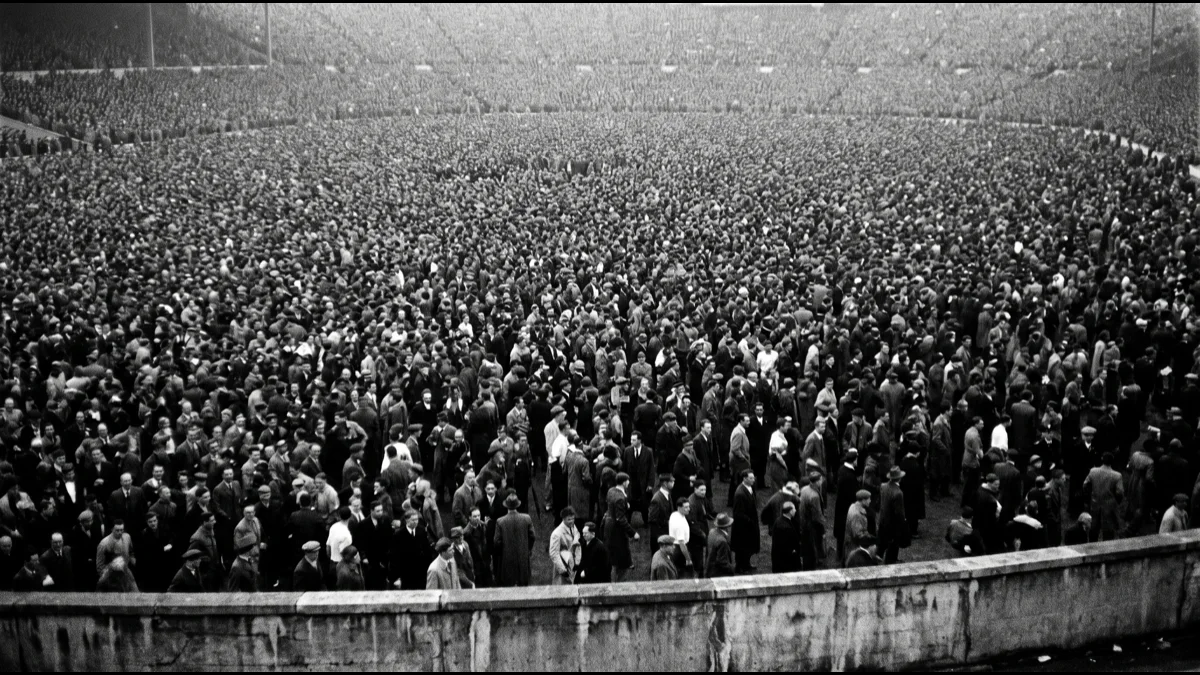
The header image is an original AI-assisted illustration in the style of a period press photograph, not an archive photograph of any real match. Where a figure is an estimate we have said so. We have not included records we could not attribute to a named source, which is why several sports readers might expect are absent rather than approximated.
The biggest soccer stadiums ranking shows today’s seating limits, while the Rose Bowl capacity guide explains one of the venues behind the historical crowd records.
Review class: stable. These records change rarely — recheck if a single-day attendance record is set, or if a governing body revises a historic figure.
Frequently asked questions
What is the highest attendance at a football match?+
173,850 paying spectators at the 1950 World Cup final between Uruguay and Brazil at the Maracanã in Rio de Janeiro on 16 July 1950. Guinness World Records recognises it as the largest attendance at any football match. Unofficial estimates put the real figure as high as 199,000 or 210,000, with thousands believed to have entered without tickets.
Will the 1950 World Cup attendance record ever be broken?+
Almost certainly not. The record was set on open terraces, and the move to all-seater stadiums for safety reasons permanently reduced how many people a given footprint can hold. Combined with modern safety certification and broadcast reach, no football crowd on that scale is likely again.
What is the largest single-day sporting event in the world?+
The Indianapolis 500, which Guinness World Records recognises as the largest attendance at a single-day sporting event. It regularly draws more than 300,000 spectators and has exceeded 350,000 in some years, against a grandstand capacity of roughly 257,000.
How can attendance be higher than capacity?+
Two ways. At venues like Indianapolis Motor Speedway, large general-admission areas — the infield in particular — hold spectators who are not counted in seated capacity. And historically, terraces packed standing crowds far more densely than modern safety certification permits.
Why is Old Trafford's record crowd bigger than its capacity?+
Because 76,962 watched the 1939 FA Cup semi-final in the standing era, while the ground's certified all-seater capacity today is 74,310. Almost every historic English attendance peak exceeds the modern capacity of the same stadium for exactly this reason.
Are attendance figures reliable?+
Less than you would expect. Some are audited gate counts, some are ticket sales, some are estimates, and some venues do not publish official figures at all. The 1950 World Cup final has both an official paid figure and much higher unofficial estimates, and both circulate as fact.
What is the difference between attendance and capacity?+
Capacity is the maximum number a venue is certified to hold in a given configuration. Attendance is how many actually came to a specific event. They are different measurements, taken on different bases, and comparing a historic attendance against a modern capacity is not comparing like with like.
Sources
- Guinness World Records: largest attendance at a FIFA World Cup match
- Guinness World Records: largest attendance at a single-day sporting event
- Wikipedia: Uruguay v Brazil, 1950 FIFA World Cup
- FIFA: Uruguay's stunning upset of Brazil, 1950 World Cup
- Top End Sports: world's largest sporting crowds
- CBS Sports: Phoenix Open sets new single-day attendance record at 201,003
Related records & rankings guides
View all →
What Is the Difference Between Stadium Capacity and Attendance?
A plain-English explanation of why a venue’s seat count and a match crowd are different numbers.

Most Watched Sporting Event: 12x the Super Bowl
The World Cup final reached about 1.5 billion people. The Super Bowl's record is 127.7 million — and charges far more per advert. Why size isn't value.

Aviva Stadium capacity: current figure, history and event limits
Aviva Stadium capacity, opening date, ownership and the configuration caveats that explain why published numbers can differ.

Bramall Lane capacity: current figure, history and event limits
Bramall Lane capacity, opening date, ownership and the configuration caveats that explain why published numbers can differ.

Craven Cottage capacity: current figure, history and event limits
Craven Cottage capacity, opening date, ownership and the configuration caveats that explain why published numbers can differ.

Elland Road capacity: current figure, history and event limits
Elland Road capacity, opening date, ownership and the configuration caveats that explain why published numbers can differ.