Most Watched Sporting Event: 12x the Super Bowl

On this page6
FIFA put the 2022 World Cup final — Argentina against France — at around 1.5 billion people worldwide across television, streaming and out-of-home viewing.
The Super Bowl’s record is 127.7 million, set in 2025. That is roughly one-twelfth as many people, for the broadcast that charges the highest advertising rates on earth.
| Event | Audience |
|---|---|
| World Cup final 2022 | ~1.5 billion (global) |
| World Cup, cumulative tournament reach | ~3.5 billion |
| Super Bowl LIX, 2025 | 127.7 million (record) |
| Super Bowl LX, 2026 | 125.6 million |
Why the smaller audience is worth more per advert
This is the part that seems wrong and is not.
A 30-second Super Bowl advert sold for $8 million to $9 million for Super Bowl LXI, as our guide to Super Bowl ad cost sets out. No World Cup final slot approaches that.
The reason is structure, not size. The Super Bowl’s 127.7 million are a single national market watching one broadcast simultaneously, which one advertiser can buy in one transaction from one broadcaster. It is the last reliably unified mass audience in American television.
World Cup viewing is spread across roughly two hundred territories and dozens of broadcasters, each selling its own advertising in its own currency to its own market. There is no single slot that reaches 1.5 billion people. The audience is larger and the addressable inventory is fragmented.
So the Super Bowl is not overpriced relative to the World Cup. It is priced for something the World Cup cannot sell.
The 1.5 billion and 3.5 billion figures are not the same
Both circulate as “the World Cup audience” and they measure entirely different things.
- 1.5 billion — the audience for the final itself.
- 3.5 billion — FIFA’s cumulative reach, the number of people who watched any World Cup coverage across the whole tournament, however briefly.
Quoting the 3.5 billion figure alongside the Super Bowl’s 127.7 million compares a month-long cumulative reach against a single-match audience. It is the same category error we found with stadium capacity, where a concert configuration gets compared against a football one — covered in our guide to the biggest stadiums in the UK.
When you see a viewership figure, the question is always: one match, or the whole tournament?
Attendance and audience are different again
The largest crowds in sport are a third measurement, and they are tiny by comparison.
The biggest attendance at any football match was 173,850 at the 1950 World Cup final, a record that all-seater conversion has made unbreakable — set out in our guide to highest attendance records. The Indianapolis 500 draws more than 300,000, the largest single-day crowd in sport.
Set against 1.5 billion watching, the people in the building are a rounding error — about one in nine thousand of the audience. That ratio is the entire economics of modern sport in a single number, and it explains why broadcast money dwarfs matchday revenue everywhere we look.
Will 2026 have broken the record?
The 2026 World Cup was widely projected to challenge the all-time mark, with 48 teams, a 104-match tournament and host markets across North America.
We are not going to assert that it did. Global audience figures take time to compile, FIFA has not published final audited numbers at the time of writing, and every claim made before then is a projection rather than a measurement. When FIFA publishes, this page will be updated.
How reliable are any of these numbers?
Less reliable than they look, and the difference between the two headline figures explains why.
Domestic ratings — the Super Bowl’s 127.7 million — come from a single measured market with an established panel. They are estimates, but consistent ones.
Global figures — the World Cup’s 1.5 billion — combine national panels, broadcaster estimates and out-of-home modelling across dozens of countries with very different measurement standards. FIFA’s numbers are the standard reference, but they are compiled rather than counted. More audience and record tables are collected in our sports records hub.
Treat the ratio as sound and the precision as approximate. The World Cup final is unambiguously the larger event; whether it is eleven times or thirteen times larger is not something anyone can state exactly.
How we checked these numbers
The 2022 World Cup final’s ~1.5 billion global audience and FIFA’s 3.5 billion cumulative reach are from FIFA via Statista’s viewership charts and Yahoo Sports’ comparison. The Super Bowl LIX record of 127.7 million and Super Bowl LX’s 125.6 million average across NBC, Peacock, Telemundo and digital are from the same reporting. The 2026 World Cup projection is from Sports Illustrated.
The two World Cup figures are stated separately on purpose, because conflating single-match audience with cumulative tournament reach is the most common error in this subject.
Review class: event-driven. Recheck when FIFA publishes audited 2026 World Cup figures, and after each Super Bowl.
Frequently asked questions
What is the most watched sporting event in the world?+
The FIFA World Cup final. FIFA put the 2022 final between Argentina and France at around 1.5 billion people worldwide across television, streaming and out-of-home viewing, which is the largest audience for any single sporting event.
How many people watch the Super Bowl?+
The record is 127.7 million, set by Super Bowl LIX between the Philadelphia Eagles and Kansas City Chiefs in 2025. Super Bowl LX in 2026 averaged 125.6 million across NBC, Peacock, Telemundo and digital platforms. Those are overwhelmingly United States figures.
Is the Super Bowl bigger than the World Cup final?+
Only in the United States. Globally the World Cup final draws roughly twelve times the Super Bowl's audience. The Super Bowl is the largest single-country television event in the world; the World Cup final is the largest event of any kind.
Why does the Super Bowl charge more for adverts than the World Cup final?+
Because its audience is a single national market watching one broadcast simultaneously, which one advertiser can buy in one transaction. World Cup viewing is spread across roughly two hundred territories and dozens of broadcasters, each selling its own advertising, so no single buyer can reach 1.5 billion people at once.
What is the difference between the 1.5 billion and 3.5 billion World Cup figures?+
They measure different things. The 1.5 billion figure is the audience for the final itself. FIFA's 3.5 billion figure is cumulative reach — the number of people who watched any World Cup coverage across the whole tournament, even briefly. Both are widely quoted as though interchangeable.
Could the 2026 World Cup be the most watched event in history?+
It was widely projected to challenge the record, with 48 teams, a 104-match tournament and host markets across North America. Final audited global figures take time to compile, so any claim made before FIFA publishes them should be treated as a projection.
Are viewership figures reliable?+
Less than their precision suggests. Domestic ratings from a single market are measured; global figures combine national panels, broadcaster estimates and out-of-home modelling across many countries. FIFA's own numbers are the standard reference for the World Cup but they are compiled, not counted.
Sources
Related records & rankings guides
View all →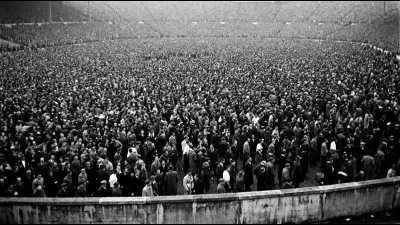
Highest Attendance Records, and Why Capacity Lies
173,850 watched the 1950 World Cup final — a record that can never be broken. Why attendance and capacity diverge in two opposite directions.

Super Bowl Ad Cost: The Year Buyers Said No
Disney asked $10m for a 30-second Super Bowl LXI spot. Advertisers refused, it sold at $8–9m, then sold out. The first public pushback on Super Bowl pricing.

Super Bowl Ticket Prices: What They Really Cost
What a Super Bowl ticket costs, why every site quotes a different average, and why face value is almost impossible to get. Prices checked August 2026.

Sports Ticket Ballots: Every Major Event's Window
When the public ballot opens for the Super Bowl, Masters, Ryder Cup, Wimbledon, Rugby World Cup and LA 2028 — and which ones have already closed.

Top 10 Female Gymnasts of All Time, Ranked
The 10 greatest female gymnasts ranked by Olympic and World medals, difficulty innovation and longevity, with a full medal table verified to 2026.
What is the Highest-Altitude Football Stadium?
A source-led guide to high-altitude football grounds, the measurement problem and why “highest” needs a defined scope.