Top 10 Largest Horse Racing Venues by Capacity (2026)
On this page6
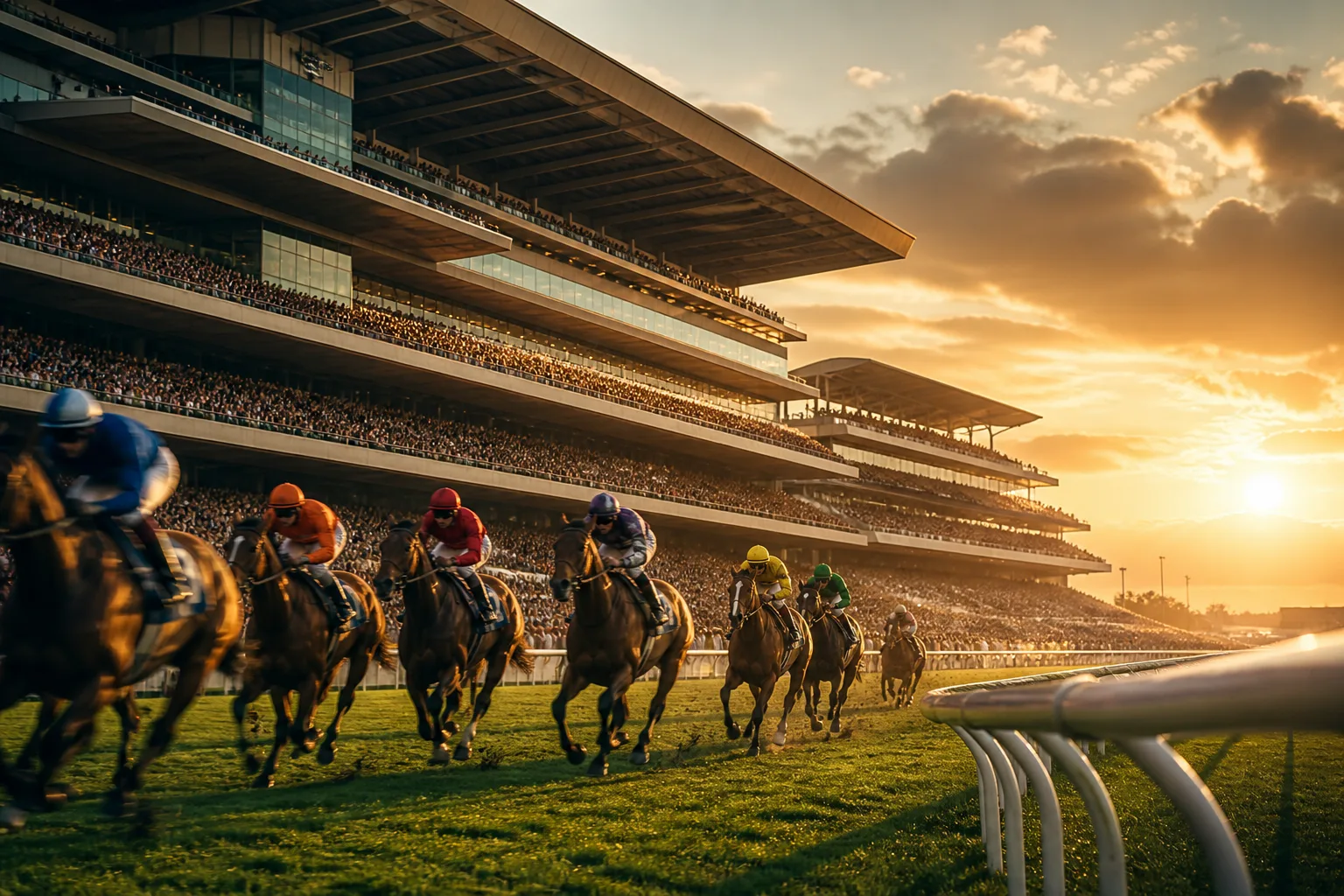
The largest horse racing venue in the world is Tokyo Racecourse in Fuchu, Japan, licensed for 223,000 spectators. Churchill Downs is the largest outside Japan at 165,000, and holds racing’s biggest verified single-day crowd: 170,513 at the 2015 Kentucky Derby. Five of the ten largest racecourses on earth are Japanese.
How we ranked racecourse capacity
The order uses each active venue’s published licensed site capacity, checked in August 2026, not its number of seats. That definition includes grandstands, lawns, enclosures and infields, so these figures must not be compared directly with all-seater stadiums. Tracks closed or operating at reduced capacity during reconstruction are excluded until their new public limit is confirmed. Equal capacities are broken by the more recently verified operator figure.
The 10 largest racecourses by capacity (2026)
Capacity here is licensed site capacity, covering grandstands, lawns, enclosures and infield rather than seats. Two historically large tracks, Belmont Park and Pimlico, are excluded because both are mid-reconstruction in 2026 and covered separately below.
| # | Racecourse | Capacity | Location | Opened | Owner or operator | Signature race |
|---|---|---|---|---|---|---|
| 1 | Tokyo Racecourse | 223,000 | Fuchu, Japan | 1933 | Japan Racing Association | Japan Cup, Tokyo Yushun |
| 2 | Nakayama Racecourse | 165,676 | Funabashi, Japan | 1907 | Japan Racing Association | Arima Kinen |
| 3 | Churchill Downs | 165,000 | Louisville, USA | 1875 | Churchill Downs Incorporated | Kentucky Derby |
| 4 | Hanshin Racecourse | 139,877 | Takarazuka, Japan | 1949 | Japan Racing Association | Takarazuka Kinen |
| 5 | Flemington Racecourse | 130,000 | Melbourne, Australia | 1840 | Victoria Racing Club | Melbourne Cup |
| 6 | Kyoto Racecourse | 120,000 | Kyoto, Japan | 1925 | Japan Racing Association | Kikuka Sho |
| 7 | Hipódromo de San Isidro | 100,000 | San Isidro, Argentina | 1935 | Jockey Club (Argentina) | Gran Premio Carlos Pellegrini |
| 8 | Sha Tin Racecourse | 85,000 | Sha Tin, Hong Kong | 1978 | Hong Kong Jockey Club | Hong Kong International Races |
| 9 | Santa Anita Park | 85,000 | Arcadia, USA | 1934 | The Stronach Group (1/ST) | Santa Anita Derby |
| 10 | Epsom Downs | 80,000 | Epsom, England | Racing since 1661 | Jockey Club Racecourses | The Derby |
Just outside the ten: Hipódromo da Gávea in Rio de Janeiro at 80,000, opened in 1926 and run by the Jockey Club Brasileiro; Aintree at 75,000, home of the Grand National since 1839; Niigata Racecourse at 75,000, built in 1965; and Ascot at 70,000, first raced in 1711 and still operated by Ascot Racecourse Ltd.
Why do Japanese racecourses dominate the list?
Because the Japan Racing Association runs a deliberately small national circuit of very large tracks rather than a long tail of small ones. Ten JRA courses stage the country’s top-level racing, so each is built for crowds that a British or American track would never need to accommodate on a single day.
The scale is easy to underestimate. Tokyo Racecourse alone is licensed for more people than the largest stadium in the world can hold, with 91,000 to spare. Nakayama, Hanshin and Kyoto would each outrank every stadium in the United States. The buildings match: Kyoto closed from November 2020 until spring 2023 purely to rebuild its grandstand for the course’s centenary, with racing moved to Hanshin and Chukyo in the meantime.
How racecourse capacity is measured, and why it beats stadiums
A racecourse capacity is a site licence, not a seat count. It covers the grandstand, the members’ lawns, the enclosures and, at tracks like Churchill Downs, an infield sold as general admission. A stadium capacity is the number of people the stands can hold.
That difference explains the whole ranking. Churchill Downs seats a fraction of 165,000; the rest of the number is standing and lawn space spread across a very large site. The same logic puts motor circuits above everything: Indianapolis Motor Speedway is licensed for around 400,000 and Le Mans for 234,800, which is why circuits and racecourses are kept off stadium lists such as the biggest stadiums in the US entirely.
Kentucky Derby and Melbourne Cup attendance records
The Kentucky Derby holds the largest verified single-day crowd in racing at 170,513, set in 2015 when American Pharoah won on his way to the Triple Crown. It beat the previous record of 165,307 from 2012.
| Event | Record crowd | Year | Venue | Note |
|---|---|---|---|---|
| Kentucky Derby | 170,513 | 2015 | Churchill Downs | Beat 165,307 set in 2012 |
| Melbourne Cup | 122,736 | 2003 | Flemington | Attendance capped near 120,000 since 2007 |
The Melbourne Cup record has a hard ceiling in front of it. After 2003, the Victoria Racing Club introduced a ticketing strategy in 2007 that caps Cup Day attendance at around 120,000 to prevent overcrowding, so 122,736 is likely to stand indefinitely. Flemington’s four-day carnival still draws a larger aggregate crowd than any single Derby day.
Both records sit above the listed capacity of most stadiums on earth, which is worth holding in mind when a racecourse and a stadium are compared on the same list.
Capacity is only half the question for anyone planning a visit — the other half is what a day costs, which varies from £30 to a membership you cannot buy. See our guide to racing tickets at Cheltenham, Aintree and Royal Ascot.
Two of the biggest racecourses are being rebuilt
Belmont Park and Pimlico are both out of the 2026 ranking because both are construction sites.
Belmont Park, historically licensed around 90,000, is in the final stage of a $455 million modernisation run by the New York Racing Association. The track reopens on 18 September 2026, but only in phase one: the Backyard paddock area and two public levels open first, with attendance capped near 6,000 while the upper grandstand is completed. The finished 275,000 square foot grandstand is designed for roughly 50,000, so Belmont will return smaller than it was and better than it was.
Pimlico Race Course in Baltimore, previously listed at 98,983, was demolished in 2025 for a $400 million state-funded reconstruction. The 2026 Preakness Stakes moved to Laurel Park, about 20 miles south, the first time in 118 years the race has been run away from Pimlico. The new course is designed for more than 100 live racing days a year against Pimlico’s recent 15, with the Preakness expected back in Baltimore in 2027.
Both projects follow the same logic as the stadium rebuilds tracked on the stadiums hub: older venues trading raw capacity for usable capacity, because a licensed 90,000 that only fills once a year is worth less than 50,000 that fills often.
Review class: stable, with event-driven triggers — recheck on any redevelopment affecting a listed capacity.
Frequently asked questions
What is the largest horse racing venue in the world?+
Tokyo Racecourse in Fuchu, Japan, licensed for 223,000 spectators. It opened in 1933 and is run by the Japan Racing Association. Only two sports venues anywhere are larger, both motor racing circuits: Indianapolis Motor Speedway and the Circuit de la Sarthe at Le Mans.
What is the largest racecourse in the United States?+
Churchill Downs in Louisville, Kentucky, at 165,000. It opened in 1875 and is owned by Churchill Downs Incorporated. Santa Anita Park in Arcadia, California is next at 85,000, ahead of Belmont Park, which is being rebuilt through 2026.
What is the record crowd for the Kentucky Derby?+
170,513, set at the 2015 Kentucky Derby, beating the previous record of 165,307 from 2012. It remains the largest verified single-day attendance at a horse race. Derby-day crowds exceed the listed capacity because the infield is sold as general admission.
What is the record crowd for the Melbourne Cup?+
122,736 at Flemington in 2003. The Victoria Racing Club introduced a ticketing strategy in 2007 that caps attendance around 120,000 to avoid overcrowding, so the 2003 figure is unlikely to be beaten under current arrangements.
Why are so many of the biggest racecourses in Japan?+
Five of the ten largest are Japanese because the Japan Racing Association operates a small number of very large national tracks rather than many small ones. Tokyo, Nakayama, Hanshin, Kyoto and Niigata are all built to hold crowds that would fill a major football stadium several times over.
Is Belmont Park still one of the biggest racecourses?+
Not at the moment. Belmont historically carried a licensed capacity around 90,000, but a $455 million rebuild has been under way and the track reopens in September 2026 with early attendance capped near 6,000 while the upper grandstand is finished. The completed grandstand is designed for roughly 50,000.
Where is the 2026 Preakness Stakes being run?+
At Laurel Park, about 20 miles south of Baltimore, because Pimlico Race Course is closed for a $400 million reconstruction. It is the first time in 118 years the Preakness has been staged away from Pimlico. The race is expected back in Baltimore in 2027.
How is racecourse capacity measured?+
As a licensed site capacity covering grandstands, lawns, enclosures and infield, not a seat count. That is why racecourses top every stadium on earth despite having far fewer seats, and why a figure like 223,000 is not directly comparable with a stadium's 132,000.
Sources
- List of horse racing venues by capacity
- Victoria Racing Club: Flemington track records and attendances
- Sports Illustrated: 2015 Kentucky Derby sets attendance record
- NYRA: Belmont Park modernization facility details
- NBC Sports: why the 2026 Preakness is at Laurel Park
- Hipódromo de San Isidro: history and 1935 opening
Related stadiums & arenas guides
View all →
Horse Racing Prize Money: Fame Doesn't Pay
The Grand National's entire £1m fund equals one Royal Ascot race. What the big meetings actually pay, and why the most famous race isn't the richest.
Largest NFL Stadiums 2026: All 30 Ranked by Capacity
MetLife Stadium is the largest NFL stadium at 82,500. All 30 venues ranked with capacity, year opened, construction cost and naming-rights holder.
Largest Stadium in the World (2026): Full Capacity Ranking
Narendra Modi Stadium is the largest stadium in the world at 132,000. Full 2026 ranking with capacity, year opened, build cost and owner for each venue.

Kentucky Derby Tickets: The Sale Opened in June 2026
2027 Derby tickets went on sale at noon on 4 June 2026 — eleven months early. And unlike the Masters or the Ryder Cup, this one is not a ballot.

Melbourne Cup Tickets: Members First, Public Later
The 2026 Cup is on 3 November and the general public sale still hasn't opened. Members are already in — and a four-day Carnival pass costs $199.
Euro 2028 Venues: All Nine Stadiums Ranked
Euro 2028 uses nine stadiums across eight UK and Irish cities. Capacities, why UEFA renames them, and the big grounds that were left out.